
Last updated November 17, 2026
 Wrought iron
 Wood & steel frame
 Farm & ranch
 Sliding driveway gates
 LiftMaster operators
Free on-site gate assessment - hinges, posts, and your LiftMaster or Nice gate operator checked before anything is quoted
The assessment is free and the quote is the invoice.
Get your free estimateDIY vs Professional Gate Parts & Welding: What’s Safe to Do Yourself
Painting over surface rust is a reasonable weekend task. Grinding out and re-welding a cracked hinge plate is not. The gap between those two jobs is where most gate damage happens, because the visual difference between cosmetic rust and structural rust eating a weld root is small, and it takes knowing exactly what to look for. Owners across Mesquite call us after a well-meaning repair turned a $180 hinge swap into a $1,400 gate replacement. This guide draws the line plainly: what you can safely handle with a wire brush and a can of paint, what needs a welder, and why the difference matters to your insurance as much as your gate.
Quick Answer
Surface cleaning, lubrication, tightening fasteners, and painting prepared metal are genuinely safe homeowner tasks. Anything involving welding, cutting, or structural steel repair is not – a gate weighing several hundred pounds can fail onto a vehicle or a person if a weld lets go. Electrical work on gate operators also belongs to a trained professional. If a crack has reached a weld, a hinge plate, or the frame itself, stop and call a professional.
Styles & brands we work with
- Wrought iron
- Wood & steel frame
- Farm & ranch
- Sliding driveway gates
- LiftMaster operators
Table of Contents
- What’s Genuinely Safe to Do Yourself
- Why Structural Welding Requires More Than a Home Welder
- How to Read a Crack: Weld, Base Metal, or Heat-Affected Zone
- Tack Welding: The Repair That Looks Done But Isn’t
- The Liability Reality of a DIY Weld on a Gate
- Gate Parts: What to Replace and What to Leave Alone
- Electrical and Automation: Where DIY Stops
What’s Genuinely Safe to Do Yourself
Homeowners ask us all the time whether they should touch their gate at all. The honest answer is yes – a good part of gate upkeep is within reach of anyone with basic tools and a little patience. The key is separating maintenance from repair, and cosmetic from structural. Maintenance keeps a sound gate sound. Repair fixes something that has already failed.
Here’s what we consider genuinely homeowner-safe:
- Surface cleaning. A stiff brush, a scraper, and a rust converter on light surface oxidation. This slows corrosion and lets you see the metal underneath, which is the first step in deciding whether you have a bigger problem.
- Lubricating hardware. Hinges, latches, rollers, and the gate operator’s drive chain. A PTFE or lithium grease applied two or three times a year keeps a gate swinging the way it was hung.
- Tightening fasteners. Loose bolts on hinge brackets, gate frames, and post anchors. Loose bolts are the leading cause of sagging gates, and a socket wrench is often the only tool you need.
- Painting prepared surfaces. Once rust is removed and the metal is clean and dry, a rust-inhibiting primer and topcoat will protect a gate for years. This is the highest-value task on the list.
- Clearing the gate path. Keeping gravel, dirt, and vegetation out of the track or swing path prevents almost as much wear as lubrication does.
Mesquite’s climate is hard on gate hardware. Summer highs above 110 degrees, blowing desert grit, and low humidity that dries out lubricant all wear on moving parts faster than in wetter climates. A gate that would go two seasons between greasings in a milder region often needs it here every three to four months. Cleaning and lubrication on that schedule is the single best thing a homeowner can do to delay a structural repair.
Why Structural Welding Requires More Than a Home Welder
A portable MIG welder from a big-box store can lay a bead that looks fine to an untrained eye. That’s the problem. It’s not the same as a structural weld on a gate frame that carries the load of a 400-pound leaf, and the difference doesn’t show up until the gate is under load – often months after the repair.
Structural gate welding requires more than the machine. It requires:
- The right process for the metal. Steel, stainless, and aluminum each want a different process, filler, and shielding gas. A MIG setup tuned for mild steel will not produce a sound weld on aluminum gate frames, and the failure mode is a crack, not a warning.
- Proper penetration. A weld that sits on top of the joint without fusing to the parent metal can look tidy and still fail under a fraction of the design load. Good penetration requires the right amperage, travel speed, and preparation of the joint.
- Pre- and post-weld treatment. Thick steel often needs preheating to avoid cracking, and a stressed weld may need stress relief. Skip that step and the weld cracks along the heat-affected zone weeks later.
- Certification that holds up. For structural steel, insurance companies and, in some cases, local code expect welds made by a qualified welder. A homeowner’s weld does not carry that weight, and if it fails, neither does the claim that the repair was done correctly.
- Safe work environment. Welding produces ultraviolet light, hot slag, and fumes, and it’s a fire hazard near dry vegetation. A gate is heavy, and it moves. Propping and lifting it safely is its own skill.
We see the result of untrained welding on Mesquite gates regularly – typically a hinge repair that held for a season and then cracked at the toe of the weld when the desert heat cycles stressed it. Our technicians have up to 13 years of experience with this exact failure mode, and it’s why we don’t approve of cosmetic welds on structural joints. If you’re not sure which category your repair falls into, a gate repair consultation in Mesquite will tell you in minutes.
How to Read a Crack: Weld, Base Metal, or Heat-Affected Zone
Not every crack is created equal. Where the crack sits determines the repair path, and training your eye on the metal is the most useful thing a homeowner can do before calling anyone. There are three places a crack on a gate can appear, and they mean very different things.
Cracks in the weld itself
A crack running through the bead of weld metal usually means the original weld was undersized, applied cold, or made on contaminated metal. This is often repairable by removing the old weld and re-welding the joint properly. When we see this on a Mesquite gate, it’s frequently on a hinge weld from a past repair – somebody re-welded the hinge once and the new bead cracked because the original weld was never ground out first.
Cracks in the base metal
A crack in the base metal – the tube or plate of the gate frame itself – is the more serious category. It usually means the gate is under a load it wasn’t designed for, often because a hinge has sagged or a post has shifted. Re-welding a base-metal crack without addressing the underlying stress is a temporary fix. The crack will return, often bigger. The correct repair is a plate or gusset reinforcement, not a fresh bead over the top.
Cracks in the heat-affected zone
The narrow band of metal immediately next to a weld is the heat-affected zone. Welding changes the metal’s structure there, and in some steels that change makes the zone more brittle. A crack running parallel to a weld, an inch or less away from it, is often a heat-affected-zone failure. These are the most difficult to repair because the fix itself involves more welding – which means managing heat input carefully. This is a welder’s job, not a homeowner’s, without exception.
Any of these three cracks means a structural repair. If you can see the crack at all, it’s already too late for a cosmetic fix. Call a professional before the gate is operated under load.
Tack Welding: The Repair That Looks Done But Isn’t
A tack weld is a small, quick fuse used during fabrication to hold parts in position before the final weld. It’s a legitimate technique inside the shop. Used as a complete repair on a gate, it’s a problem – and it’s the single most common shortcut we find on gates in Mesquite that a previous “repairman” touched.
A tack weld holds the two pieces together with a small dot of fused metal rather than a continuous bead along the full joint. It looks finished, especially once it’s painted. It isn’t. The tack carries only a fraction of the load the joint should carry, and under a gate’s constant cycling – open, closed, open, closed, hundreds of times a month – it cracks and lets go. The failure can be sudden.
How to spot a tack weld on a repair:
- Look for dots, not a line. A proper structural weld runs the length of the joint. A tack weld appears as one or two small lumps.
- Check the paint line. Suspiciously thick paint over a joint can hide a tack, especially on a repair that’s older than a few months.
- Tap it with a small hammer. A solid bead gives a bright metallic ring. A tack weld or a cold weld sounds dull and hollow.
- Look for a repair that “worked” for one season. A tack weld that held through the winter and then failed is exactly the pattern that should send you to a professional.
When we come behind another company’s welding, the most common thing we find is a tack where a bead should be. It’s never a matter of whether it will fail, only when. On a driveway gate in Mesquite, that failure happens during an open or close cycle, often with a vehicle or a person in the swing path.
The Liability Reality of a DIY Weld on a Gate
There’s a reason the trade draws the line at structural welding, and it’s not gatekeeping. It’s liability. A gate is a heavy, moving object on a residential property, and if a weld you made fails and injures someone or damages a vehicle, the consequences are not just financial.
The homeowner insurance complication is real. A typical homeowner’s policy covers negligent workmanship by a contractor up to a point, but it does not always cover a structural failure caused by the homeowner’s own unpermitted or uncertified repair. In some cases, the insurer can decline the claim entirely, arguing the damage was the result of the homeowner’s own work. And if a guest, a delivery driver, or a passing child is injured when a gate leaf drops, the exposure can be sizable.
A professional repair changes that picture. A licensed, insured gate company carries its own liability protection on the work, and a written guarantee stands behind the weld. When we complete a structural repair in Mesquite, the customer’s only concern is whether the gate closes the way it did when it was hung. The insurance exposure is ours, not theirs.
This is also why we don’t cut corners on the weld itself. The 90-Day Done Right Promise exists because we’ve been on the wrong end of another crew’s quick repair more than once, and we know what a proper structural weld looks like versus a weld that’s hoping to get through the week.
Gate Parts: What to Replace and What to Leave Alone
Parts are a different calculation from welding. A worn hinge, a failed latch, or a tired roller is a low-consequence swap that a homeowner can often manage. A gate operator’s control board, a safety sensor, or a motor capacitor is not, and the boundary is the same as everywhere else on this list: if the part carries structural or electrical load, it’s a professional’s job.
Homeowner-safe part swaps on a typical Mesquite gate:
- Gate hinges. On a light pedestrian gate or a modest driveway gate, hinge replacement is a reasonable task if the hinge bolt pattern matches and the gate can be safely propped during the swap.
- Latches and handles. Purely mechanical, no load-bearing risk. A good candidate for a homeowner repair.
- Rollers and track hardware. Sliding gate rollers wear out, and replacing them is a straightforward swap once the gate is safely supported.
- Bumpers and stops. Cosmetic and protective, not structural.
What belongs to a professional:
- Post anchors and foundation plates. A loose post anchor is often a structural symptom, not a simple bolt swap.
- Gate operator motors, control boards, and safety sensors. Electrical, coded, and often brand-specific. We service LiftMaster, FAAC, BFT, and Linear operators regularly, and each brand has its own quirks. A wrong-part swap can blow a board and cost more than the original repair.
- Any part that carries the swing load of the gate. If the part holds up the gate, it’s structural.
If you’ve got a newer automated gate and want a straight answer on whether a part is safe to swap, our gate motor and opener team in Mesquite can tell you which brand you’re working with and whether a homeowner swap is safe. For a new gate altogether, see our gate installation service in Mesquite.
Electrical and Automation: Where DIY Stops
The gate operator is the one component on the property where we don’t recommend a homeowner touch anything beyond the reset button. The automation on a modern driveway gate is 120-volt or low-voltage control wiring, safety sensors, and a control board that expects specific inputs. A mistake on the electrical side ranges from a blown board to a dead short, and an improperly set safety sensor can defeat the gate’s ability to reverse on contact – a genuine hazard.
What’s safe on the automation side:
- Reading the manufacturer’s manual and following the manufacturer’s maintenance schedule.
- Changing the remote battery and re-syncing a remote using the manufacturer’s instructions.
- Cleaning the safety sensor lenses with a soft cloth.
- Testing the auto-reverse feature on a regular schedule (put a two-by-four in the gate’s path and watch whether it reverses).
What’s not:
- Replacing the control board, motor capacitor, or transformer.
- Re-wiring safety sensors, keypads, or intercoms.
- Adjusting torque, speed, or limit settings beyond the manual’s consumer-level recommendations.
An operator that trips its breaker, runs in the wrong direction, or won’t reverse on contact is a call-it-in problem. We work on the nine major brands – including LiftMaster, FAAC, BFT, Linear, Viking, Ghost Controls, DoorKing, Elite, and Mighty Mule – and a technician with the right parts on hand often resolves the problem on the first visit.
Common Mistakes to Avoid
- Welding a hinge back on without grinding out the old weld. The new bead won’t penetrate properly and will crack within a season. Grinding the joint clean first is not optional.
- Painting over structural rust. Rust that’s started to eat a weld root looks similar to surface rust from the outside. If the paint bubbles within a month, the rust underneath was deeper than it looked.
- Using a tack weld as a full repair on a hinge or frame joint. It looks finished and holds for a few months. It is not a structural weld, and it will fail under a gate’s cycling load.
- Increasing the operator’s force settings to overcome a binding gate. That’s a symptom-fix that hides a mechanical problem and increases the risk of injury. The gate needs freeing, not more force.
- Replacing a heavy gate’s hinge with a lighter hardware-store hinge. A matched hinge is one rated for the gate’s weight. A lighter hinge is a hinge that will bend.
- Ignoring Mesquite’s blowing grit in roller tracks. Desert wind deposits sand in sliding-gate tracks faster than in most climates. A weekly track sweep and a monthly greasing prevents more wear than almost any other habit.
- Repairing a crack in the heat-affected zone with more welding at home. Heat-affected-zone cracks often return unless heat input is controlled. This is the repair most likely to fail twice when done DIY.
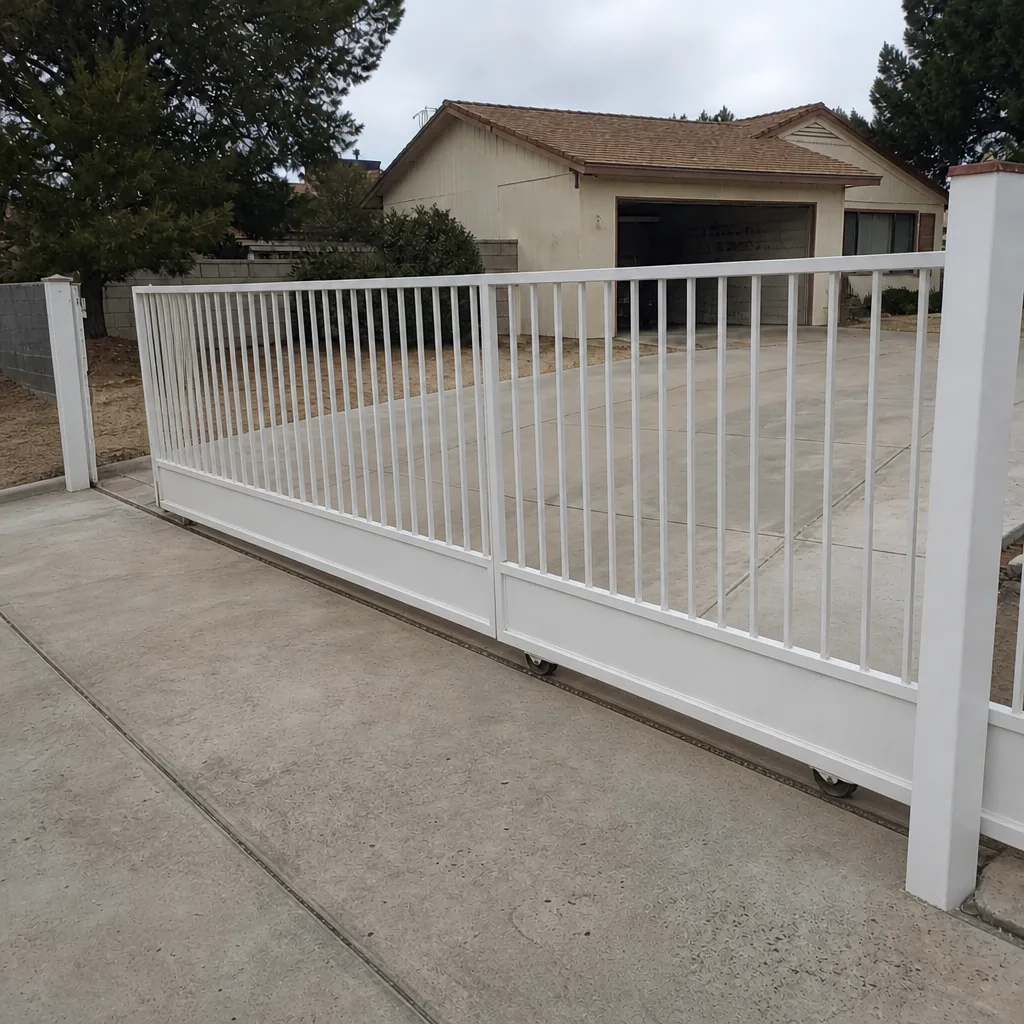
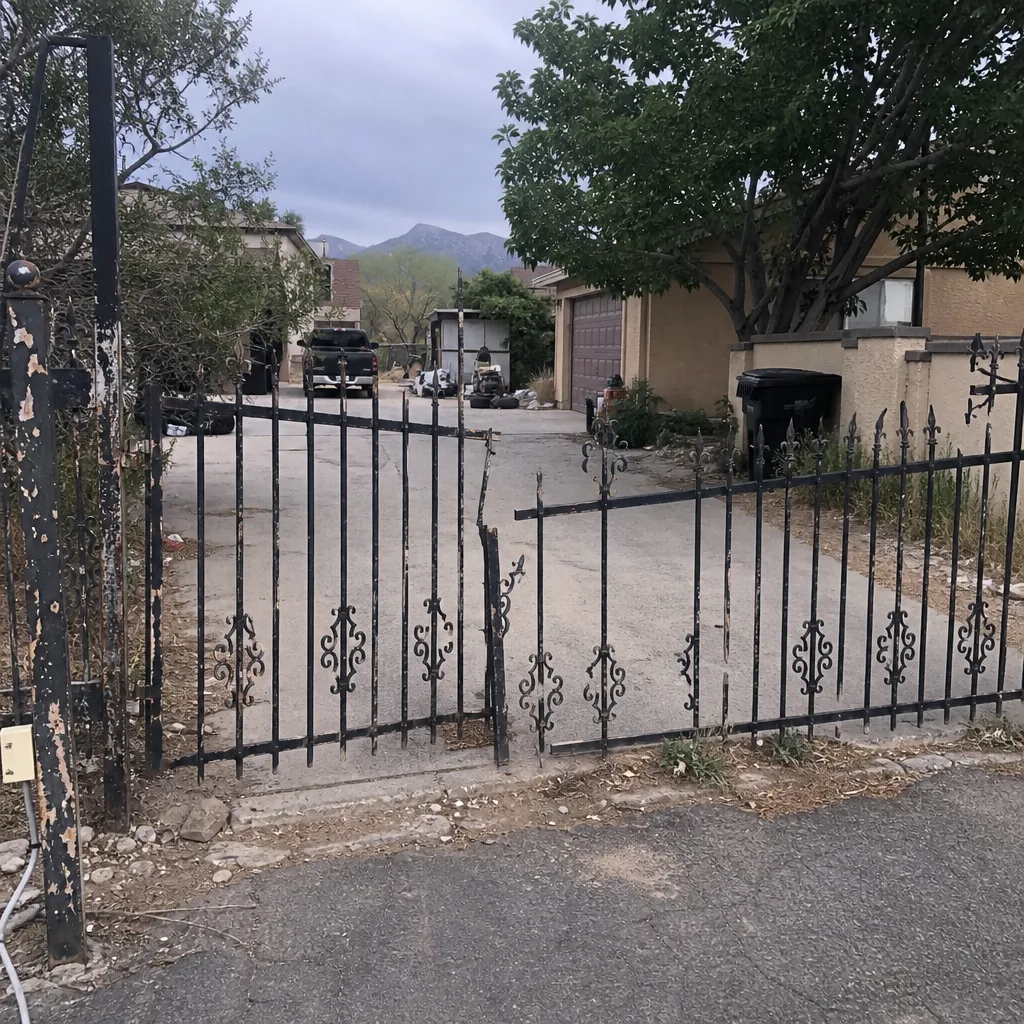
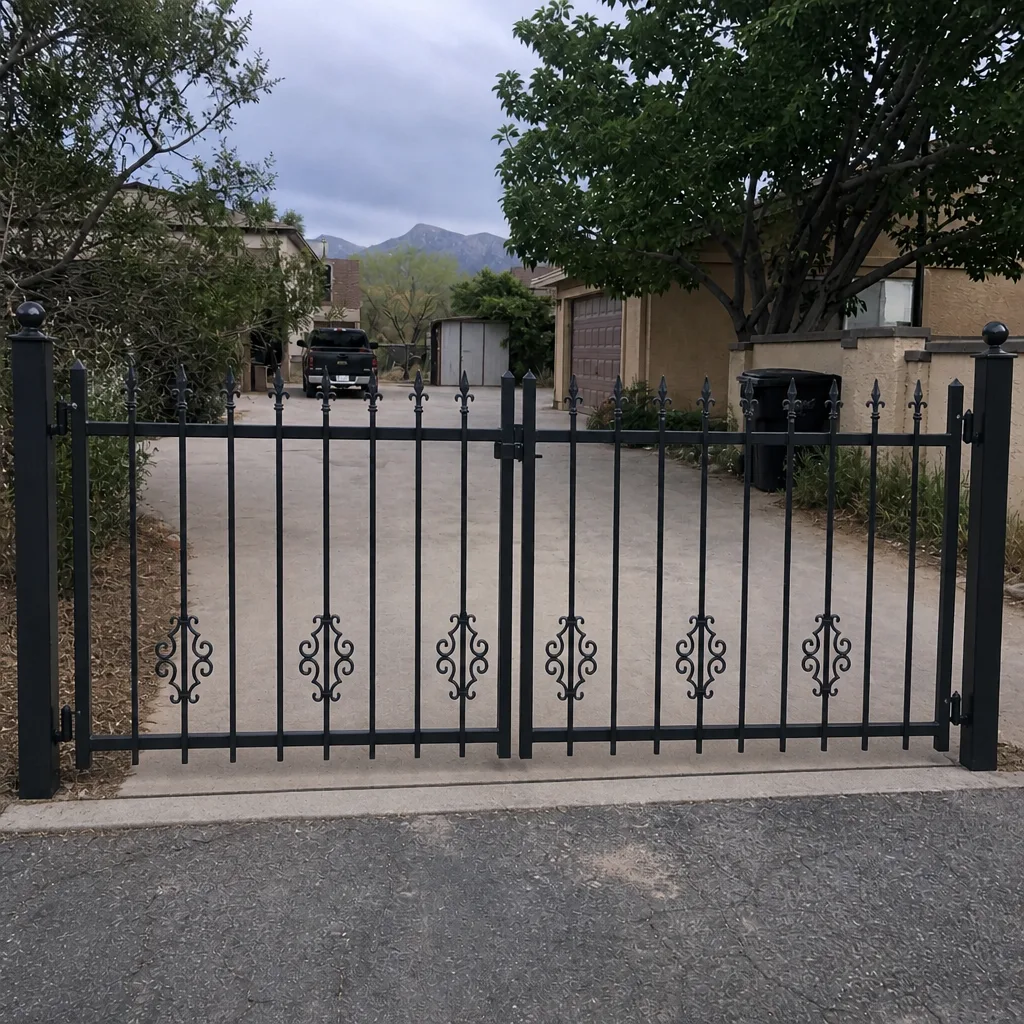
See the difference
 Before
 After
 Before
 After
 Before
 After
When to Call a Professional
Call a professional the moment any of these apply: you can see a crack in the weld, in the frame, or in the metal next to a weld; the gate has dropped, sagged, or stopped closing squarely; a hinge plate has separated from the frame; the gate operator won’t reverse on contact, trips its breaker, or runs in the wrong direction; a repair by someone else has failed within a year; the gate leaf weighs more than a homeowner can safely lift or prop alone. Ironworks Gate Co. Mesquite offers free estimates in Mesquite – call (844) 797-2573. A live person answers, and no one has to spend twenty minutes in a voicemail tree.
Frequently Asked Questions
No, not on any structural part of the gate. A homeowner MIG welder can produce a bead that looks fine but doesn’t penetrate structurally, and a failed weld on a heavy gate can drop the leaf onto a vehicle or a person. Cosmetic welding on a non-structural ornament is one thing; welding anything that carries the gate’s load is a professional’s job.
The rust needs to be removed and treated before paint goes on. Surface rust can be wire-brushed and treated with a rust converter, then primed. Rust that’s started to eat a weld root cannot be painted over – the paint will bubble within weeks and the rust will keep eating underneath. If you’re not sure which kind you have, it’s worth a professional eye.
A tack weld is one or two small dot-fuses holding two parts together; a proper structural weld is a continuous bead running the full length of the joint. A tack looks complete once it’s painted and holds for a few months, but it carries a fraction of the structural load. On a driveway gate in Mesquite, we find tack welds on past hinge repairs more often than we’d like.
Often not. Most homeowner policies cover negligent workmanship by a licensed contractor up to a limit, but a structural failure from a homeowner’s own uncertified repair can be denied. When the work is done by a licensed, insured gate company, the company’s liability attaches to the work, and you’re not carrying the exposure.
Yes. Hinges on lighter gates, latches, rollers, and bumpers are reasonable homeowner swaps as long as the gate is safely propped. Post anchors, gate operator motors and control boards, safety sensors, and any part that carries the gate’s swing load belong to a professional.
No – that’s a safety-sensor or control-board issue, and adjusting the settings at home can make the gate more dangerous, not less. A gate that won’t reverse on contact is a repair-in-this-week problem. Call us and we’ll get a technician out to diagnose it.
Every three to four months in this climate, more often than a wetter region would need. Grease the hinges and rollers, sweep grit from the sliding track, tighten visible bolts, and inspect the welds at hinge points and post connections. That schedule is the cheapest structural maintenance there is.
The Bottom Line
The safe DIY boundary on a gate isn’t about skill – it’s about consequence. Cleaning, lubricating, tightening, and painting cost $50 and make a sound gate last longer. Structural welding, cutting, and operator-electrical work carry the risk of a 400-pound leaf failing onto a vehicle or a person, and the insurance exposure that follows. If a crack has reached a weld, a hinge plate, or the frame, stop, and get it looked at. The right repair is the last one you’ll need to think about, and it comes with a written guarantee behind it. For anything on the structural or automation side, our gate repair team at Ironworks Gate Co. Mesquite is the call that gets it done right.
Contact
If your gate is showing cracks, sagging, or an operator that isn’t behaving, call Ironworks Gate Co. Mesquite at (844) 797-2573 for a free estimate. We’ll tell you what’s safe to handle yourself and what needs a professional, quote the price before any work starts, and stand behind every repair with our 90-Day Done Right Promise. Current offers include $50 Off Any Repair Over $250, a Free Second Opinion on Any Written Estimate, an $89 Seasonal Tune-Up, and a permanent 5% Senior and Veteran discount. Call today.
Written by the team at Ironworks Gate Co. Mesquite.