
Last updated November 17, 2026
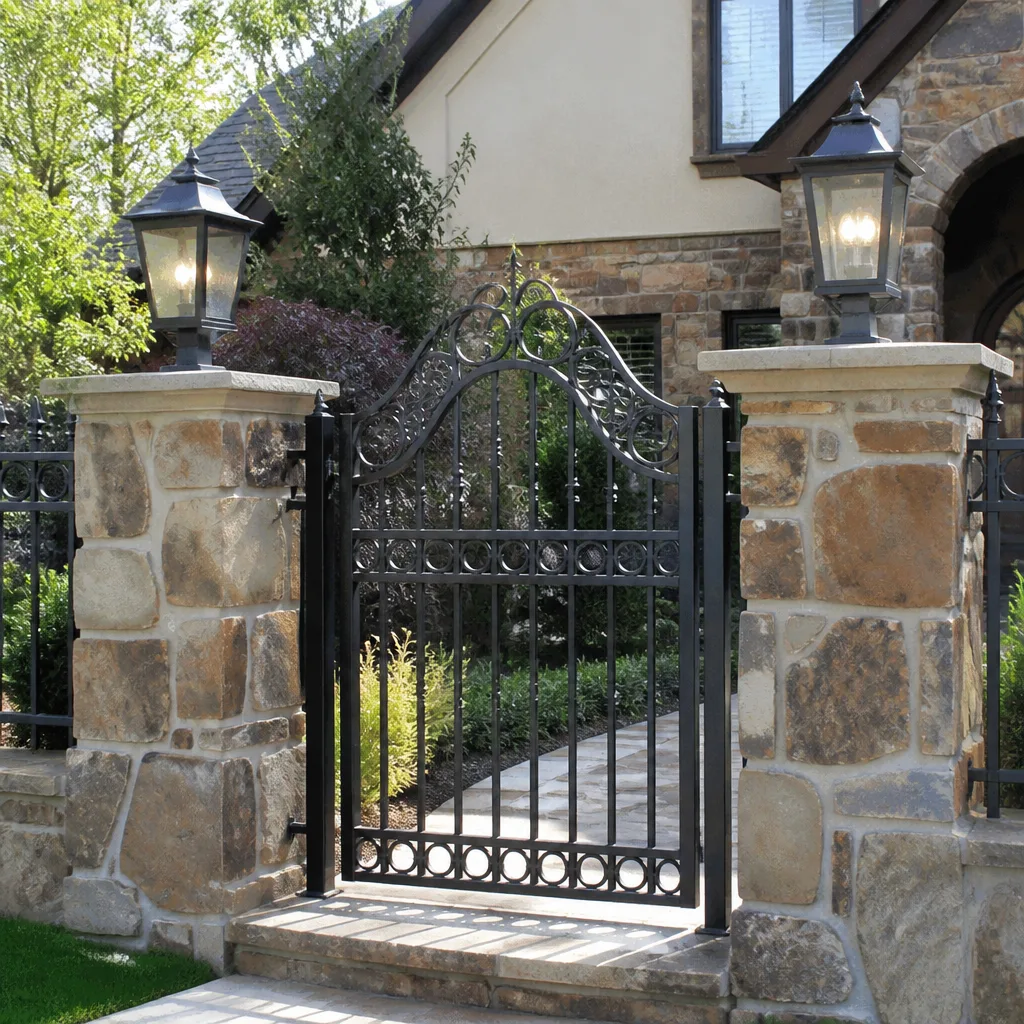 Wrought iron
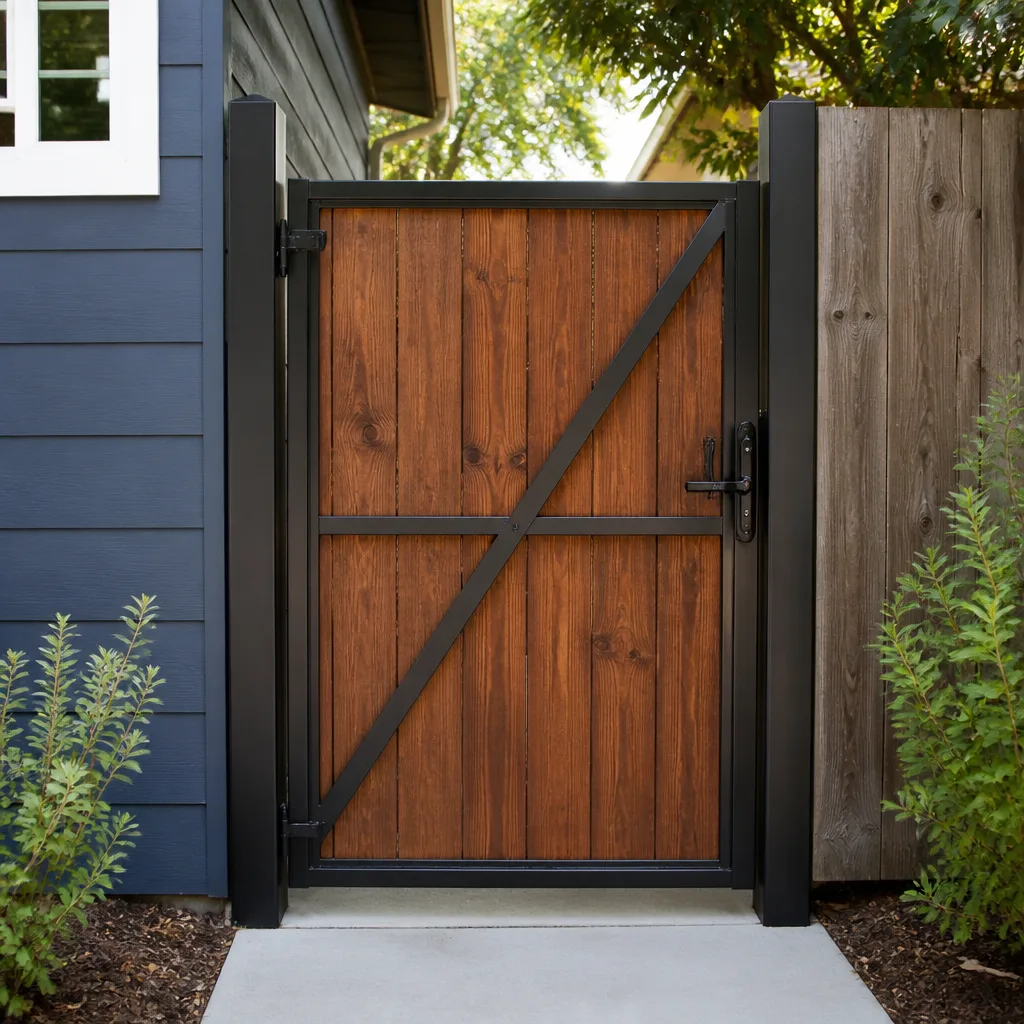 Wood & steel frame
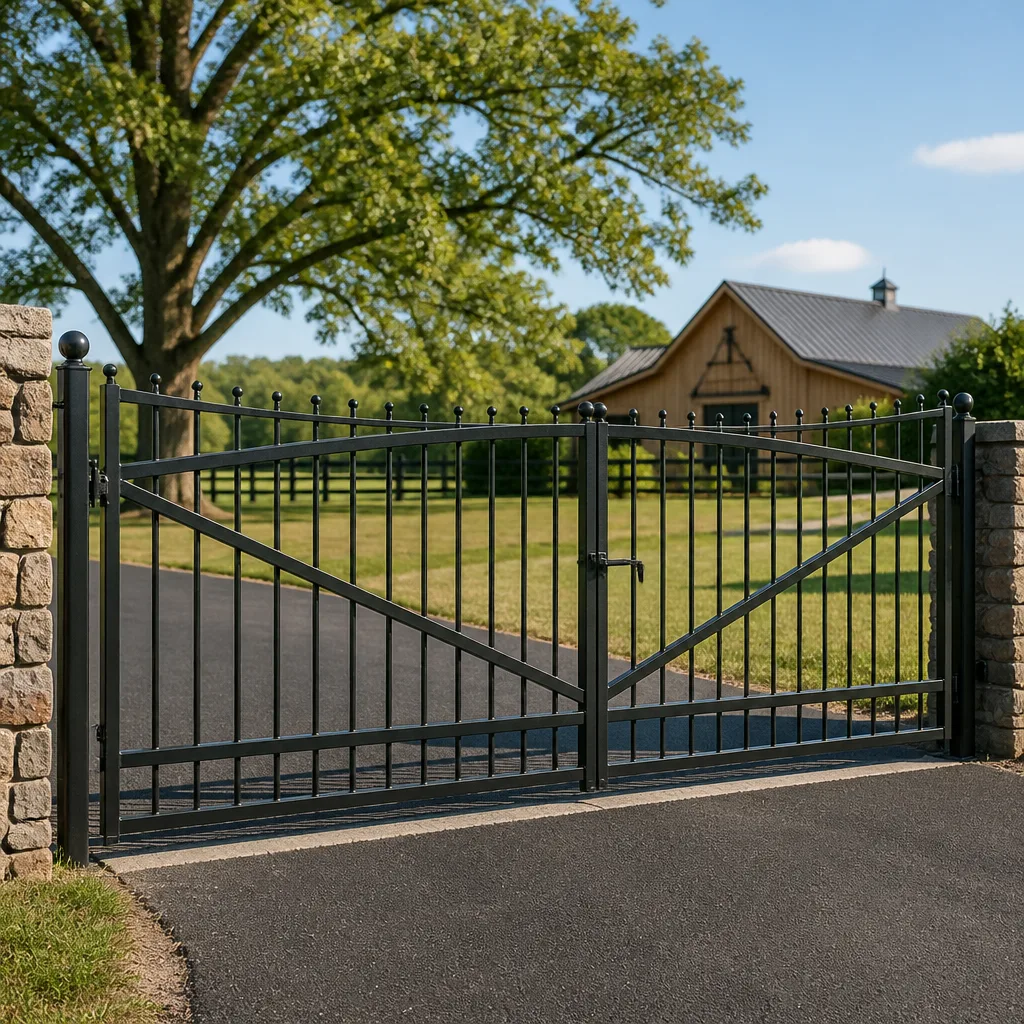 Farm & ranch
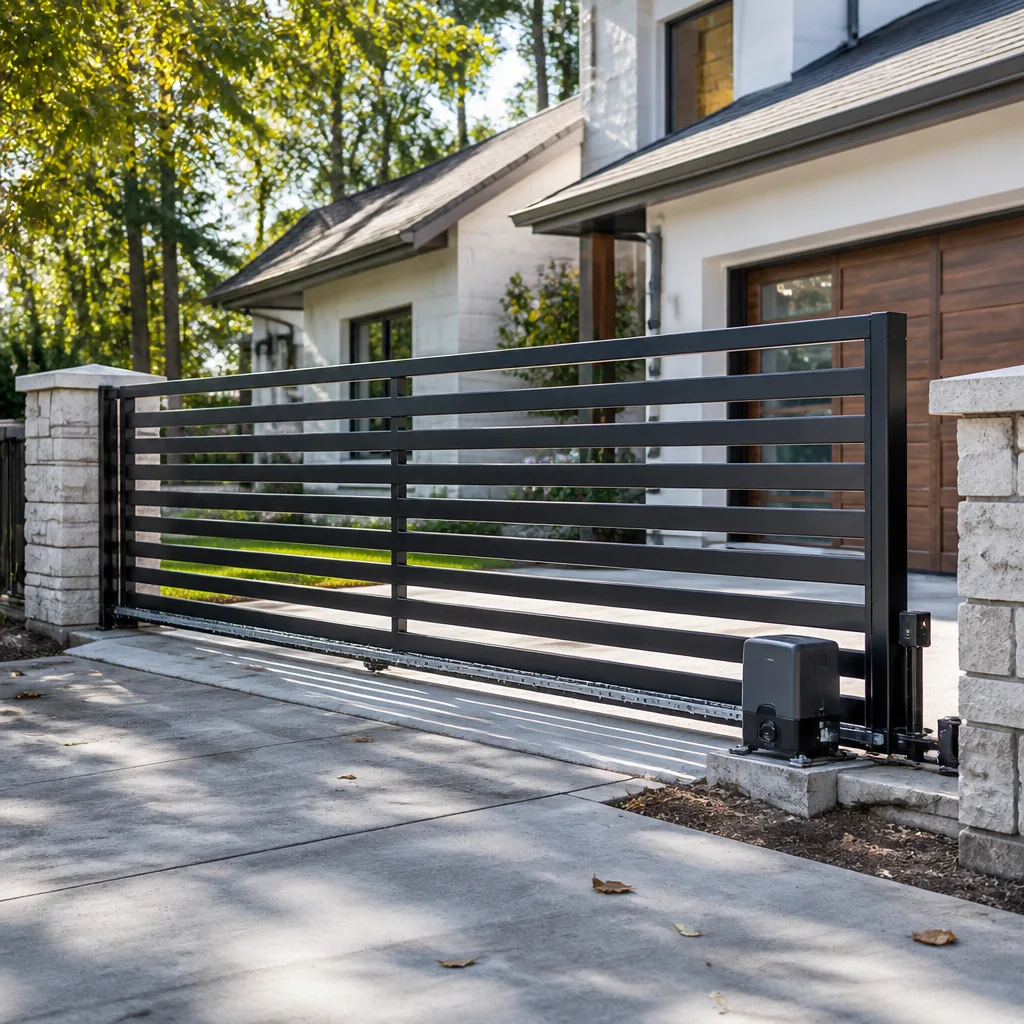 Sliding driveway gates
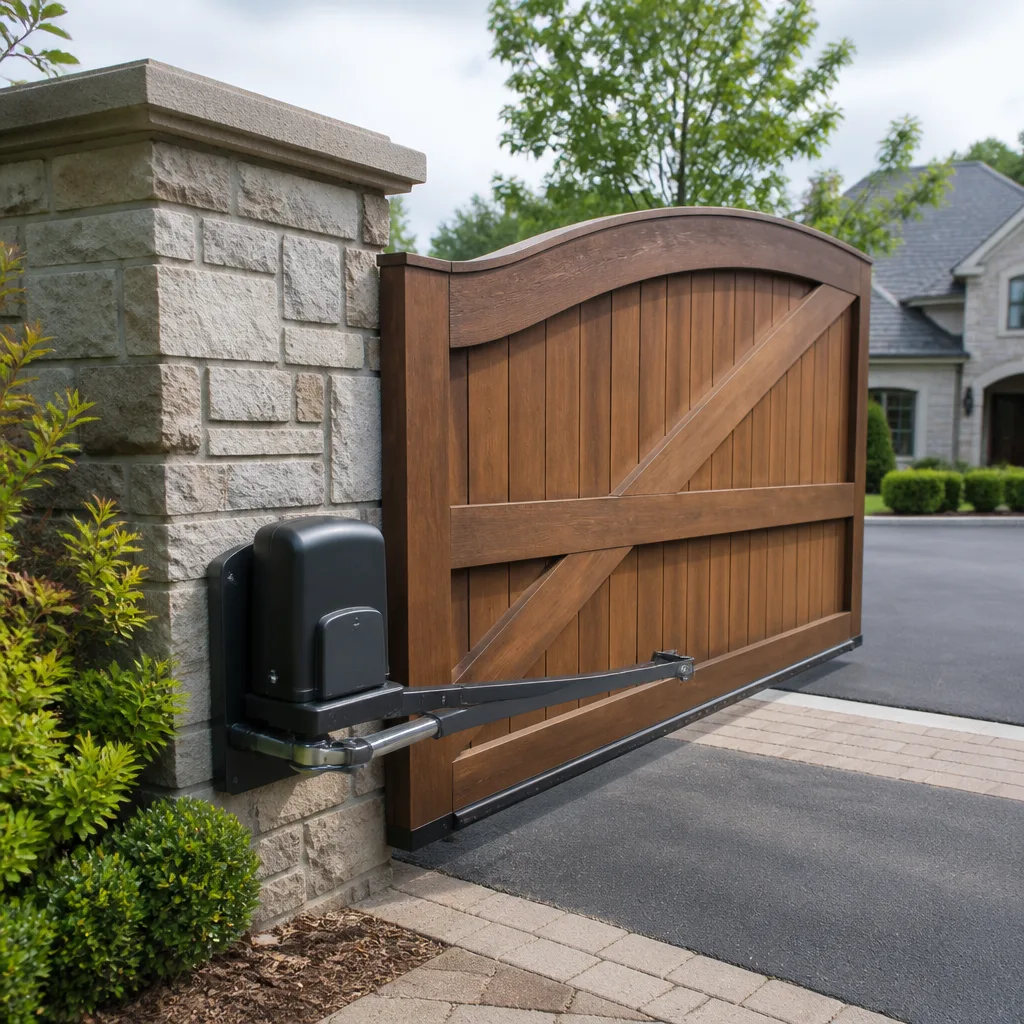 LiftMaster operators
Free on-site gate assessment - hinges, posts, and your LiftMaster or Nice gate operator checked before anything is quoted
The assessment is free and the quote is the invoice.
Get your free estimateDIY vs Professional Gate Repair: The Mesquite Homeowner’s Decision Guide
He replaced the battery, adjusted the limit switches, and lubricated every hinge. The gate still failed. It failed because the problem was a cracked weld at the hinge post, a hairline crack he never saw, slowly opening under the weight of a twelve-foot steel leaf every time the operator cycled. He spent a Saturday and about $70 on parts that were never the problem. In our experience, this is the most common DIY gate story we hear in Mesquite: not a homeowner who couldn’t handle a wrench, but a homeowner who fixed the wrong system. This guide will show you how to identify which of your gate’s three systems is actually failing before you touch anything, so you spend your effort where the failure lives.
Quick Answer
The DIY-versus-professional question for gate repair in Mesquite isn’t really about cost or confidence. It’s about diagnosis. If you can correctly identify whether the failure is structural (frame, posts, welds), mechanical (hinges, rollers, tracks, latches), or electrical (motor, board, safety sensors, access control), you can handle about half of what goes wrong and should stop before the other half. Misdiagnosing a structural failure as an automation problem routinely turns a $50 weld into a $600 repair, and that’s the mistake this guide is built to prevent.
Styles & brands we work with
- Wrought iron
- Wood & steel frame
- Farm & ranch
- Sliding driveway gates
- LiftMaster operators
Table of Contents
- The Three Systems in Every Gate
- The Three-Question Diagnostic Framework
- What You Can Safely Do Yourself
- The Automation Warranty Trap
- The Hidden Cost of DIY Structural Work
- Why Mesquite Gates Fail Differently
- A Go/No-Go Decision Chart
- What Professional Repair Actually Costs in Mesquite
The Three Systems in Every Gate
Every automated driveway gate, whether it’s a sliding cantilever on a Mesquite estate lot or a swing gate at the end of a long gravel drive in Bunkerville, is really three systems stacked on top of each other. Understanding them separately is the entire foundation of good gate decisions.
Structure. This is the frame, the posts, the hinges, the welds, and the foundation footings. It carries the weight of the gate leaf and absorbs every cycle of motion. When structure fails, everything above it fails in confusing ways.
Hardware. Hinges, rollers, tracks, guide wheels, latches, and stops. These are the moving interfaces between the leaf and the frame. They wear predictably and usually announce their failure with noise, sag, or drag.
Automation. The motor, control board, safety sensors, limit switches, keypad, and remote receivers. This system only does what the structure and hardware allow it to do. If a gate drags because a hinge is shot, the operator will strain, overheat, or trip its current sensor, and a homeowner will assume the motor is bad.
That last point is where almost every DIY misdiagnosis begins. We’ve walked up to Mesquite gates where the homeowner had already bought a new operator, only to find the real problem was a hinge pin that had seized solid. The operator was fine. The gate couldn’t move.
The Three-Question Diagnostic Framework
Before you touch a single bolt, run these three questions in order. They take about five minutes and cost nothing.
- Does the gate move freely by hand with the operator disengaged? Every automated gate has a manual release. Disengage the operator, then push the gate through its full travel by hand. If it binds, drags, grinds, or needs force to move, your problem is structural or mechanical, not electrical. Stop here. Do not replace the motor.
- Is the gate hanging straight, and are the posts and welds intact? Sight down the gate leaf from the end and check for sag, twisting, or gap at the hinge side. Look at the welds with a flashlight, particularly where hinges meet the frame. A cracked weld is often a dark hairline, not an obvious break. If you see flex, sag, or a crack, it’s structural and it’s professional territory.
- Does the gate move freely by hand, but the operator refuses to run it? Now you’re in electrical. Check the obvious first: power at the outlet, the breaker, the control board fuse, and whether the safety sensors are obstructed or misaligned. If the gate passes questions 1 and 2 and fails here, the failure is in automation.
That’s the whole diagnostic. Structure and hardware failures are the ones that punish DIY work. Automation failures are often a genuine fixable-at-home problem, though the warranty trap below complicates the picture more than most homeowners realize.
What You Can Safely Do Yourself
We’re not in the business of telling homeowners they can’t touch their own property. Plenty of gate maintenance is straightforward and worth doing. Here’s what belongs in that category, with the tools and actions spelled out.
Safe to handle yourself:
- Clearing the gate path. Gravel, sand, and debris in the track or under the leaf cause more “motor failures” in Mesquite than anything else. A stiff broom and a few minutes keeps a sliding gate running clean.
- Lubricating hinges and rollers. A can of silicone or lithium grease on the hinge pins and roller bearings every few months is genuinely good maintenance. Don’t use WD-40 as a long-term lubricant; it attracts dust in desert conditions and dries out.
- Replacing remote batteries. A CR2032 or 9-volt in the handset, no tools beyond a small screwdriver.
- Cleaning and aligning safety sensor lenses. A soft cloth and a visual check that the two sensor eyes face each other. If the gate reverses for no reason, this is your first check.
- Clearing vegetation from the gate’s travel. Ocotillo, palo verde, and desert broom grow fast and can block a photo-eye or push against a gate leaf, which the operator reads as an obstruction.
- Replacing a keypad battery. Most keypads lift off the post with a single screw.
Not safe to handle yourself:
- Any weld repair on the frame, hinge, or post. A failed weld can drop a 300-pound gate leaf.
- Resetting or re-pouring a gate post. An improperly set post will shift under the weight of the automation and take the operator with it.
- Adjusting limit switches on an operator you don’t have the manual for. A mis-set limit can drive the gate past its stop and rack the whole frame.
- Any work inside the motor housing or control board.
- Running or modifying the low-voltage control wiring, and any 120-volt power work at the operator.
Notice that the safe list is almost entirely cleaning, lubrication, and batteries. That’s the honest boundary. Everything past it belongs to someone with a welder and a licensed electrician’s understanding of the operator, which is exactly the combination a dedicated gate repair company in Mesquite brings to a job.
The Automation Warranty Trap
Here’s the part most Mesquite homeowners have never been told. The manufacturer’s warranty on your gate operator is conditional, and several routine DIY actions void it. Not “may void it.” Void it, in the manufacturer’s written terms. This is where a lot of well-intentioned self-repair gets expensive.
Across the brands we service daily, the pattern is consistent:
- Opening the operator housing to adjust the control board voids coverage on most of the nine major brands. The board is sealed for a reason; the manufacturer treats a homeowner’s hand inside it as the end of their obligation.
- Adjusting limit switches without documentation is treated by several manufacturers as a modification of factory calibration, which disqualifies a subsequent board or motor claim.
- Adding or swapping a battery in a backup-equipped operator is fine, but replacing the backup battery with a non-OEM part voids the backup circuit coverage specifically. This catches homeowners on Ghost Controls and Elite units in particular.
- Reprogramming the receiver or adding a third-party remote can void the receiver warranty if the remote isn’t on the compatible list. Viking and DoorKing both specify compatible accessories in their manuals.
- Running your own power to a new operator location is the single fastest way to void the entire electrical warranty, and it’s also a code issue in Clark County.
If you bought a new home with a previously installed operator, the warranty clock started with that unit, not with you, and the remaining coverage is worth protecting. Before any DIY work inside the motor housing, read the manual for the specific void conditions. If you’ve already done the work and the operator failed afterward, that’s a conversation worth having with a technician before you buy a replacement. We’ve seen warranties saved in cases like this more than once.
The Hidden Cost of DIY Structural Work
A homeowner with a MIG welder in the garage or a buddy who welds for a living can absolutely repair a gate weld. What often goes wrong is the repair itself, not the willingness. And the cost of a bad structural repair is almost never limited to the structure.
Picture a hinge post that’s begun to lean. The homeowner resets it five degrees off-level, adds some concrete, and the gate closes. Six weeks later, the gate is dragging. The operator is straining and overheating. The homeowner assumes the operator is failing and calls us. We find the gate leaf is now misaligned with the operator arm by a quarter inch at the closed stop, which over cycles wears the drive gear. A $200 post reset done wrong turns into a $650 automation repair on top of the original problem. That’s the pattern, and in our work on Mesquite gates we see it weekly.
The same thing happens with welds. A weld repaired in the wrong place, with the gate leaf out of square, loads the hinge and the operator unevenly. The gate leaf itself can twist over a few months, and once a frame twists, the repair is no longer a small one. It’s a rebuild.
This is why the DIY-versus-professional calculation for structural work isn’t about the cost of the weld. It’s about the reliability of the geometry that follows the weld. A structural repair done under professional eyes includes verifying the gate is square, the hinge line is true, the operator limits still match the actual stops, and the post is set to spec. That whole package is what you’re paying for, and it’s the package that keeps the automation from becoming the second casualty.
Why Mesquite Gates Fail Differently
Gate repair in Mesquite has a specific flavor that inland and coastal gate repair doesn’t share. Two things drive it.
Thermal cycling. Mesquite swings from summer highs that regularly cross 110°F to winter nights that dip toward freezing. Steel gate frames expand and contract across that range, and the welds at the hinge side take the most stress. In our experience, late spring and early fall are when hidden weld cracks start announcing themselves in Mesquite, sometimes after years of nothing. The kind of crack that wouldn’t faze a coastal gate can become a structural problem here within one season.
Wind and dust. Spring and early summer winds in Mesquite push sand into every exposed mechanical joint. Hinge pins, rollers, and track wheels get an abrasive paste that inland gates never see, and that paste wears bearings faster than the calendar suggests. We routinely find Mesquite hardware with cosmetic age that doesn’t match its internal wear. A five-year-old gate with desert exposure can have the wear of a ten-year-old gate in a milder climate.
What this means for a homeowner: don’t trust the gate’s age as a proxy for the condition of its hardware and welds. If your gate is in a wind-exposed driveway on the north end of Mesquite, or at the edge of a development where dirt roads still feed onto paved ones, the hinges and welds need a visual inspection once or twice a year, not once a decade.
A Go/No-Go Decision Chart
Here’s the practical version. Match your failure to the table below. This is the core of the Ironworks Gate Co. Mesquite home approach to triage: get the diagnosis right, and the decision falls out of it.
- Remote won’t open the gate, but the wall keypad works. DIY. Replace the remote battery, then reprogram. No structural risk.
- Gate reverses for no reason. DIY first. Clean and align the photo-eyes, check for obstruction, verify the manual release isn’t engaged. If it persists, professional.
- Gate drags, grinds, or sags. Professional. This is hardware or structure, and diagnosing it by hand is the fastest path to a correct fix.
- Gate runs but stops short of full open or close. Professional. Limit adjustment on an unfamiliar operator can rack a frame.
- Cracked weld at any hinge or frame junction. Professional. Full stop. This is a safety issue and a secondary-damage issue.
- Operator hums but gate doesn’t move. Professional. Could be a seized hinge (mechanical) misread as a motor failure, or a genuine motor/bearing failure. Either way it’s not a homeowner fix.
- Keypad or access code stopped working. DIY for battery, professional for receiver or board.
- Gate is over 15 years old and starting to fail in multiple ways. Professional assessment, and worth a candid conversation about whether gate installation in Mesquite is the better answer than repeated repair.
The rule of thumb: if the failure appears only when the operator is engaged, and the gate moves smoothly by hand, it’s automation and you can often handle the easy end of it. If the gate fails to move smoothly by hand, or if you see or suspect a structural problem, the professional cost pencils out even at twice the material cost, because the alternative is a second repair stacked on the first.
What Professional Repair Actually Costs in Mesquite
Homeowners ask us constantly whether professional repair is worth it versus DIY. The honest answer requires actual numbers, so here’s what gate repair typically runs in Mesquite. Every job is quoted and agreed before work starts, and no work happens until you’ve seen the price.
- Remote or keypad reprogramming or battery replacement: $75 to $140
- Photo-eye realignment or replacement: $110 to $225
- Hinge replacement (per hinge, parts and labor): $90 to $180
- Limit switch adjustment: $95 to $175
- Weld repair on a hinge or frame junction: $180 to $400
- Post reset or re-set footing: $350 to $750
- Control board replacement: $280 to $580
- Operator motor replacement: $450 to $950
- Full operator replacement with new unit: $850 to $1,900 depending on brand and gate type
Compare that to the DIY path on a structural failure. Material cost might be $40 of welding rod and rod stock. The second repair, when the geometry isn’t right, is often $300 to $700 on the automation side. The DIY savings on the weld disappear and then some the moment the operator pays for it. And an operator repair done on the same visit as the structural repair typically costs less than two separate trips, which is part of why most of our gate repairs in Mesquite finish in a single visit.
When the gate’s automation itself has reached the end of its life, the math shifts. That’s the conversation to have with a dedicated gate motor and opener specialist in Mesquite, who can tell you whether your existing operator is worth repairing or replacing before you commit.
Common Mistakes to Avoid
- Replacing the operator before diagnosing the gate. If the gate doesn’t move freely by hand, the operator isn’t failing. It’s fighting. Replace it and the new motor inherits the same problem.
- Ignoring a hairline weld crack because the gate “still works.” A cracked weld doesn’t fail gradually. It fails suddenly, under load, and a 300-pound gate leaf dropping on a driveway is a serious injury risk. Get a cracked weld looked at now, not when it drops.
- Power-washing the operator “clean.” The control board housing on a gate operator is not water-tight, and water inside an operator housing in a Mesquite summer is a dead board by fall. A dry brush and compressed air is all it needs.
- Running power to a new operator location yourself. In Clark County this is a licensed electrician’s job, and there’s no safe version of doing it as a homeowner. It’s a code issue, a safety issue, and a warranty issue.
- Resetting a post with bagged concrete and guessing the height. A gate post is the foundation of the automation. If it’s off in any dimension, the gate is off with it. This one deserves professional eyes.
- Assuming a 15-year-old gate that “just needs a new battery” needs only a new battery. Desert hardware on a gate that age almost always has more than one problem brewing. Get a real assessment before you spend on parts.
- Using WD-40 as a long-term hinge lubricant. It cleans and displaces water, then dries out. In desert dust it attracts grit and accelerates wear. Use a proper silicone or lithium lubricant instead.
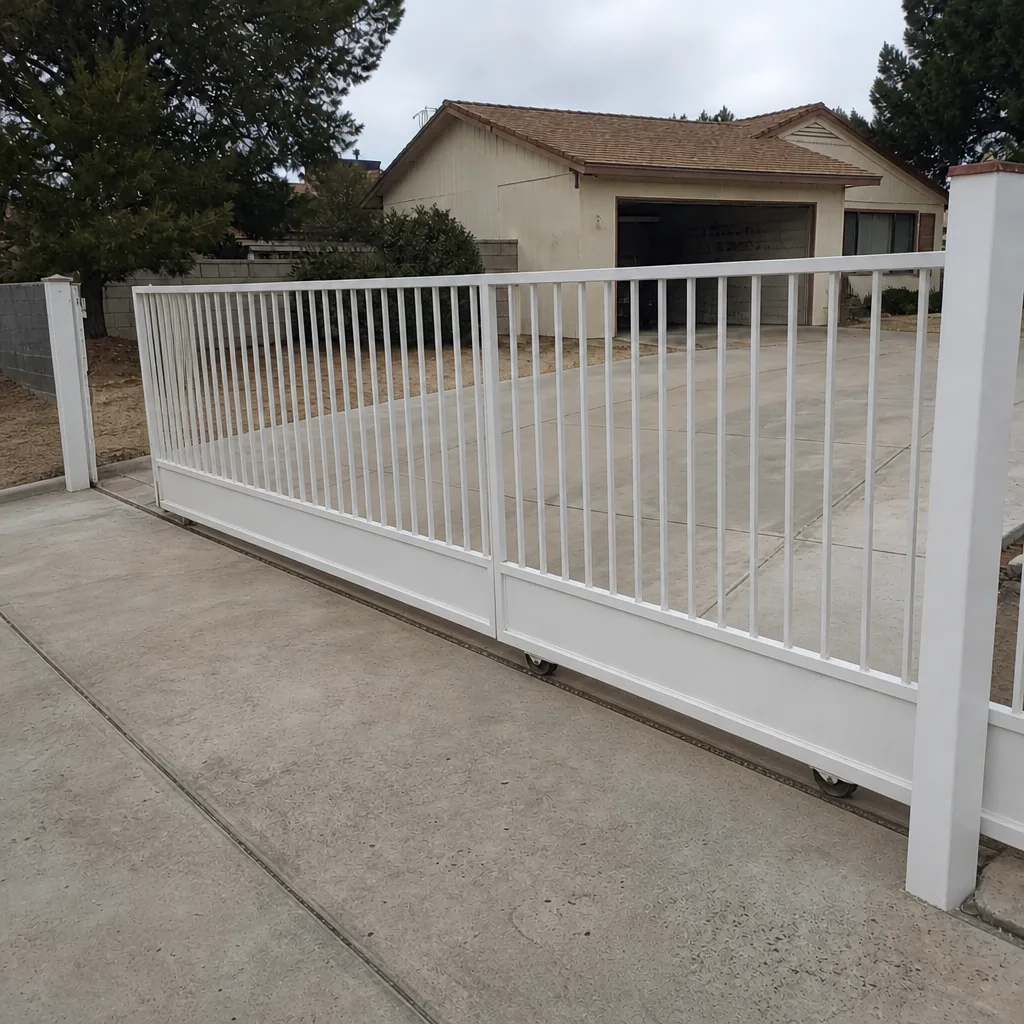
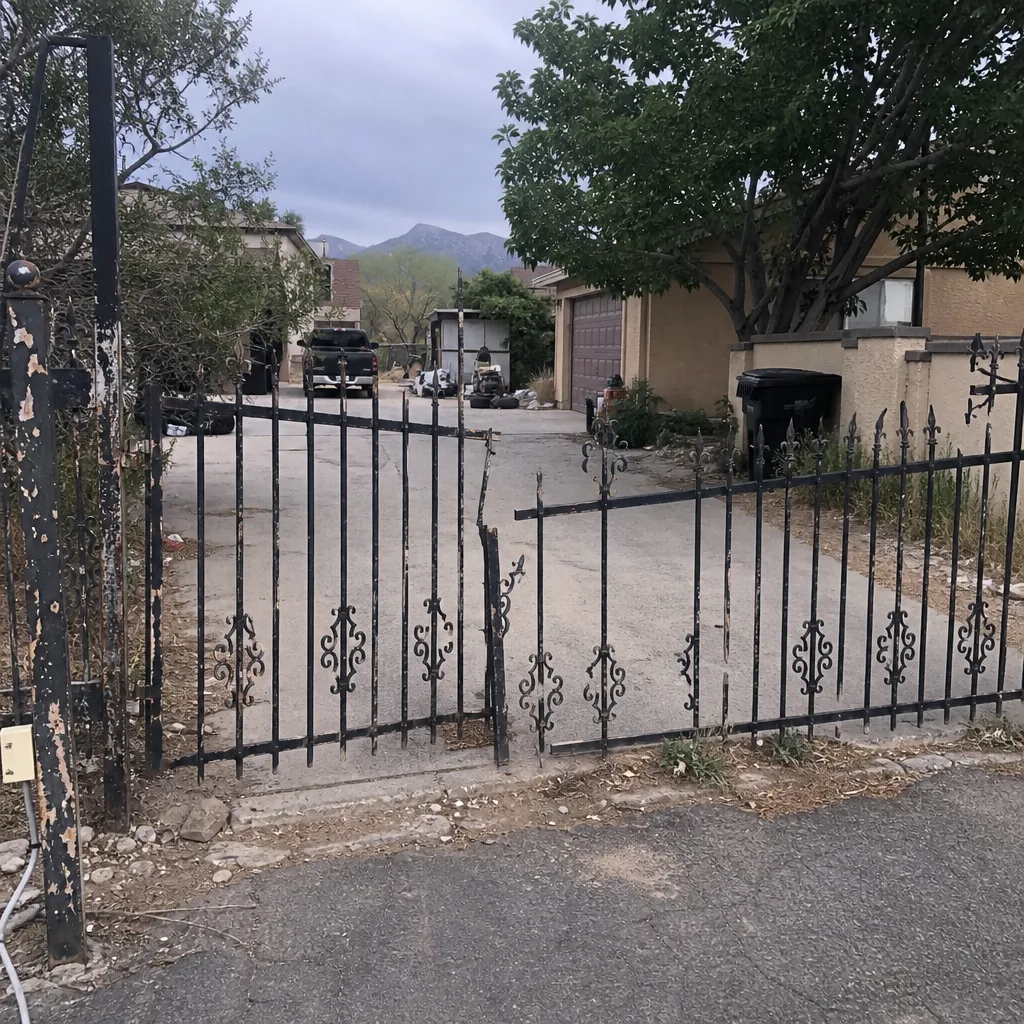
See the difference
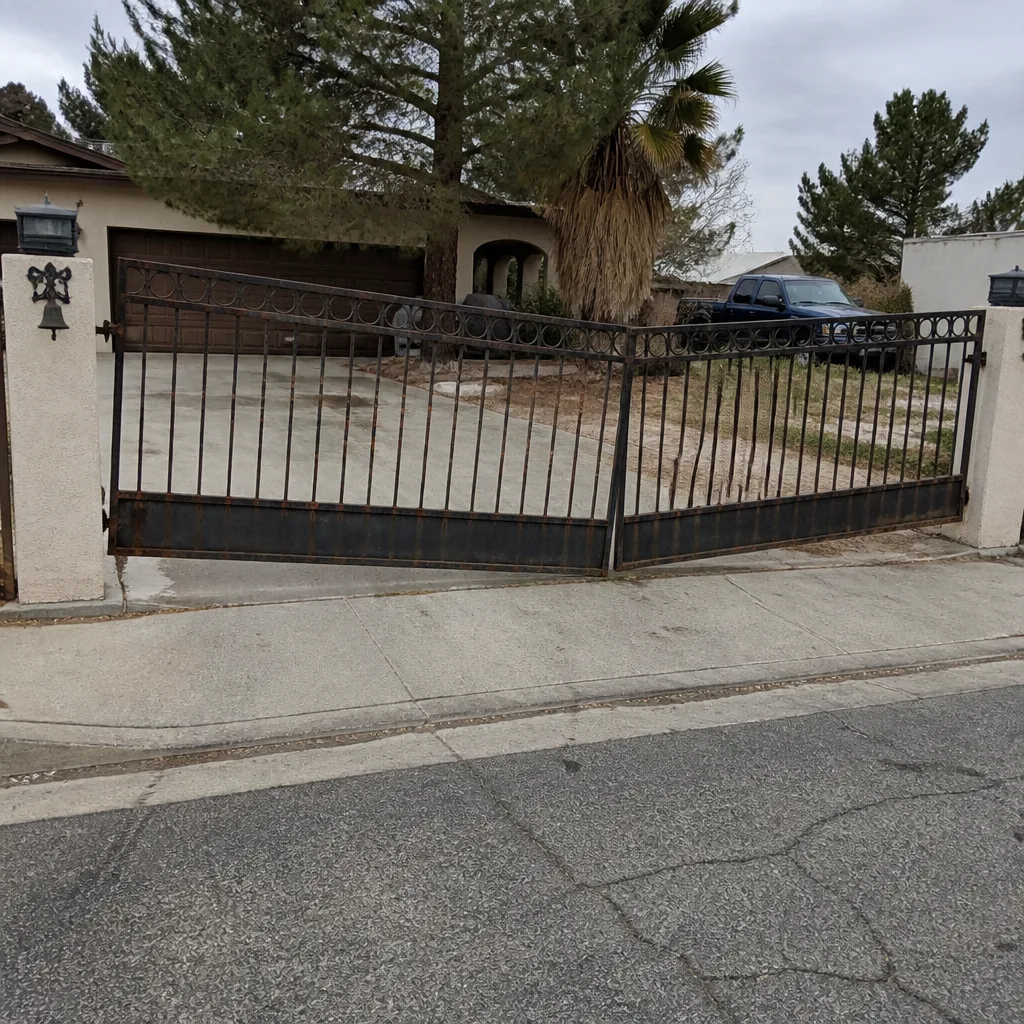 Before
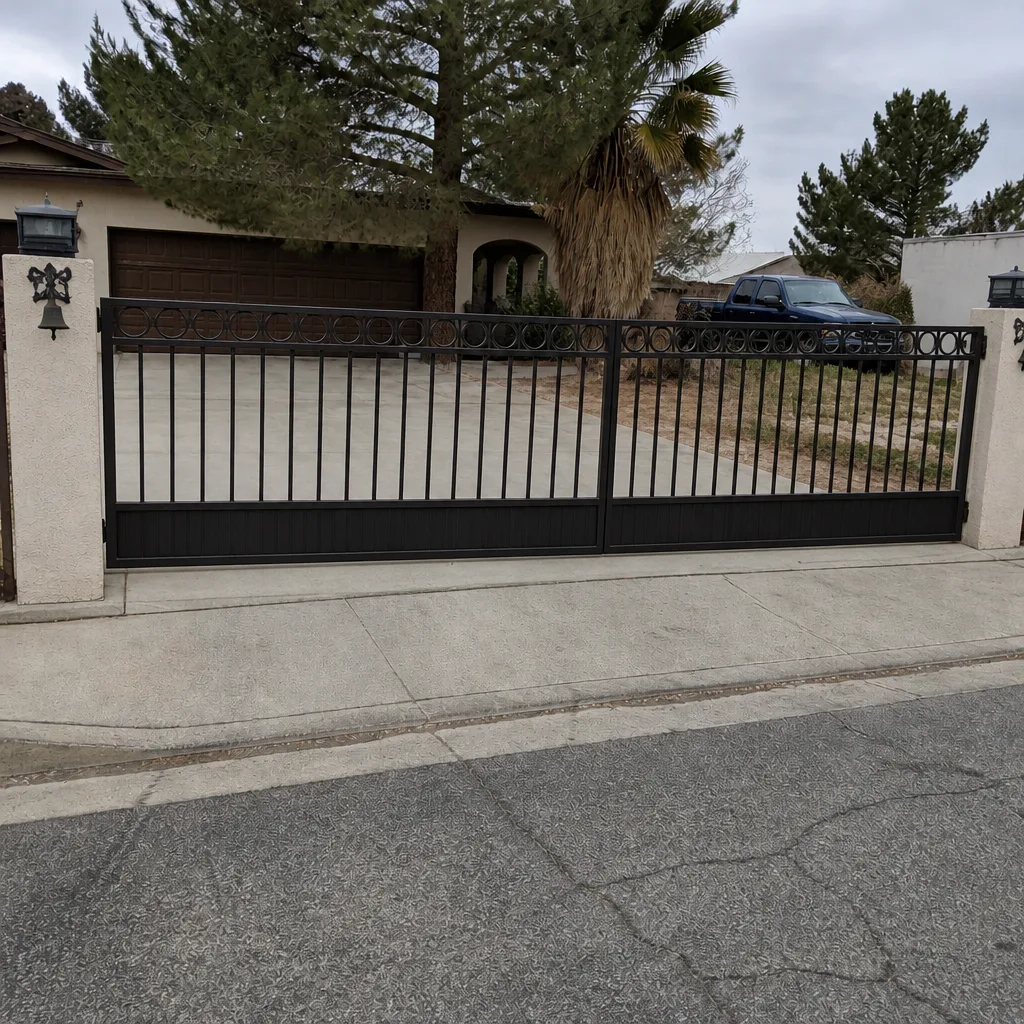 After
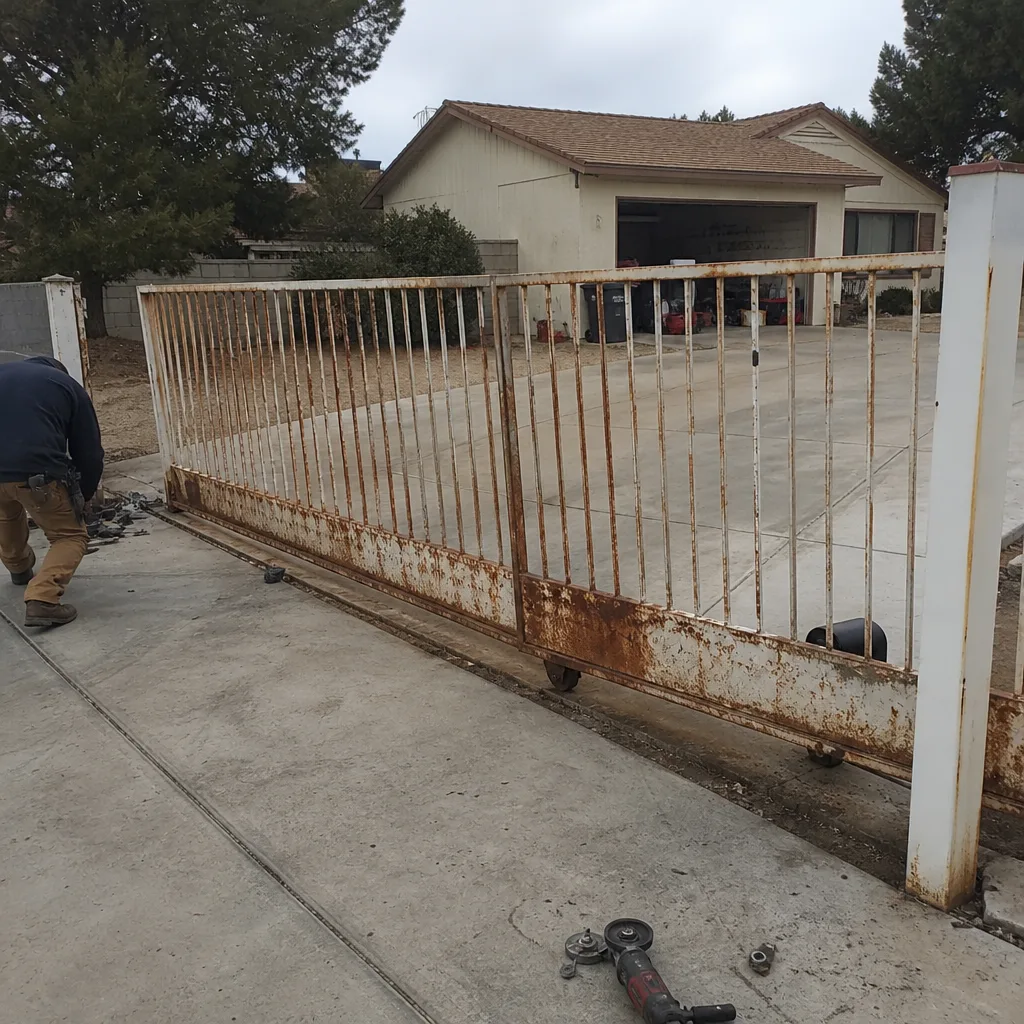 Before
 After
 Before
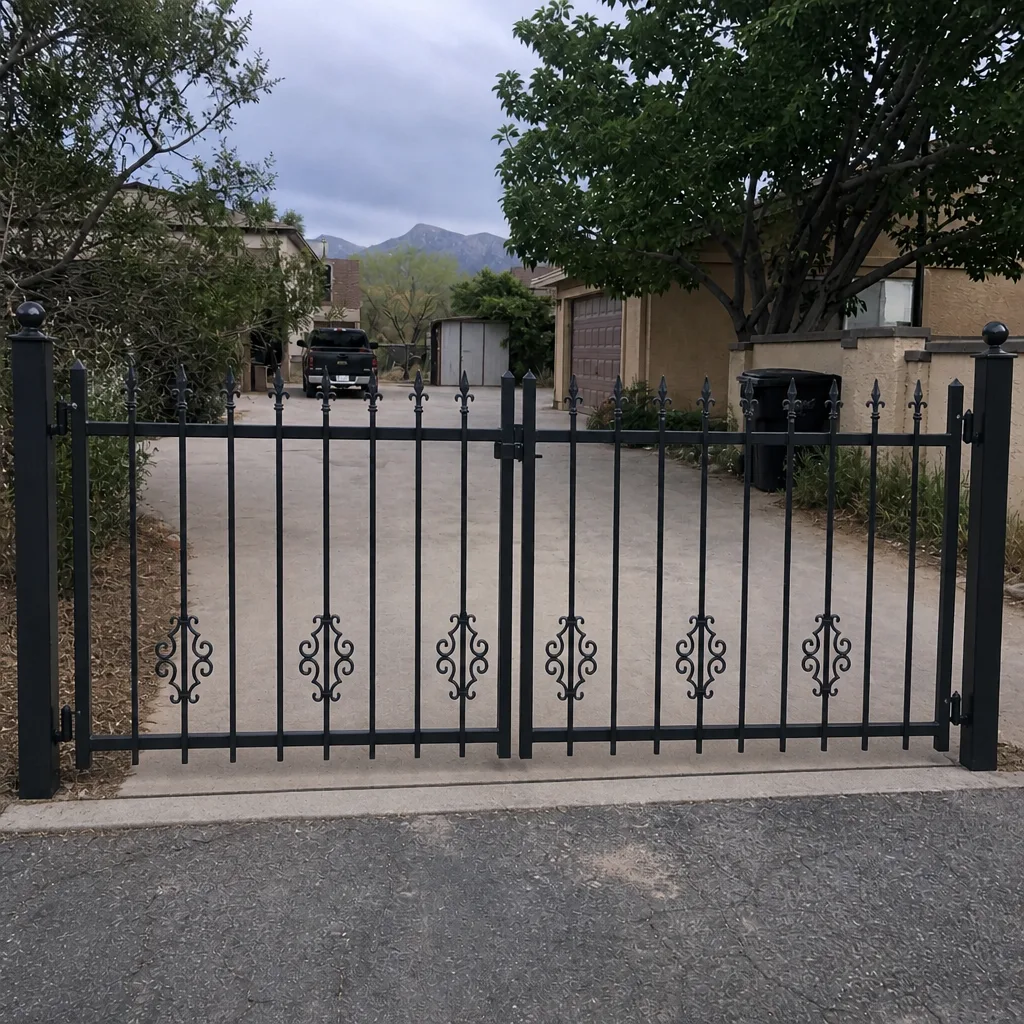 After
When to Call a Professional
Call a professional if the gate won’t move freely by hand, if you see any crack at a weld, if the gate leaf sags or drags, if the operator hums without moving the gate, if the gate stops short of its stops, or if you’re not sure which system is failing. Age and repeated failures also merit a call: a gate over fifteen years old that has failed twice in six months is telling you something about the automation or the structure, and it’s worth a trained look before you spend another dollar on parts. We’ve worked with Mesquite homeowners on all of these scenarios, and a second opinion on a written estimate is free. Ironworks Gate Co. Mesquite offers free estimates in Mesquite – call (844) 797-2573.
Frequently Asked Questions
No, and we’d advise against attempting it. Gate opener motors are heavy, wired to 120-volt power, and integrated with safety sensors and limits that must be calibrated to the specific gate. Replacing one without calibration risks injury and voids the manufacturer’s coverage on the new unit. A qualified professional handles it safely and keeps the warranty intact.
Usually, yes, if the structure and posts are sound. Steel frames outlast their hardware and automation by a wide margin, so most 20-year-old gates in Mesquite need hinges, welds, and possibly a new operator, not a new gate. The answer is different if the posts have moved or the frame has twisted. That’s a case where gate installation may actually be the better money.
Most gate repairs in Mesquite fall between $90 and $580 depending on what fails. Hinge and photo-eye work sits at the low end; operator and control board work sits at the high end. A cracked weld repair runs $180 to $400, and a post reset runs $350 to $750. Call for an exact quote – estimates are free and pricing is agreed before any work starts.
We’d strongly advise against it. A weld repair on a gate isn’t just about laying the metal; it’s about whether the leaf is square, whether the hinge line is true, and whether the operator’s limits still match the actual stops afterward. A DIY weld that gets the gate out of square loads the operator unevenly and can turn a $200 weld into a $650 automation repair. This is professional territory.
Often, yes. Opening the operator housing, adjusting limit switches without documentation, replacing backup batteries with non-OEM parts, and running your own power all void coverage on most of the major brands. If a gate operator fails after DIY work, call before buying a replacement; we’ve saved manufacturer coverage on jobs where the homeowner assumed the warranty was already gone.
Because DIY fixes so often address the wrong system. Replacing a battery or adjusting limits on a gate that has a cracked weld or a seized hinge doesn’t fix the failing component, so the gate keeps failing. Get the diagnosis right and the repair will hold. That’s the entire point of the three-question framework. Call us for a free second opinion on any written estimate if a DIY fix didn’t hold.
The Bottom Line
Gate repair isn’t a confidence problem, and it isn’t a cost problem. It’s a diagnosis problem. Your gate has three systems, and the failure almost always lives in one and reads as another. Clean, lubricate, replace batteries, align your sensors, clear your vegetation. That’s the honest DIY list. Stop before any weld, any post, and any work inside the operator housing, because the second repair after a bad first one is where the real money goes. When the diagnosis is unclear or the failure points to structure, have a trained technician look at it. A Mesquite company that services all nine major automation brands and can weld its own structural repairs will get the fix right the first time and back it in writing. Call (844) 797-2573 for a free estimate – the diagnosis is free, and the quote is agreed before a bolt is turned.
Written by the team at Ironworks Gate Co. Mesquite.