
Last updated November 17, 2026
 Wrought iron
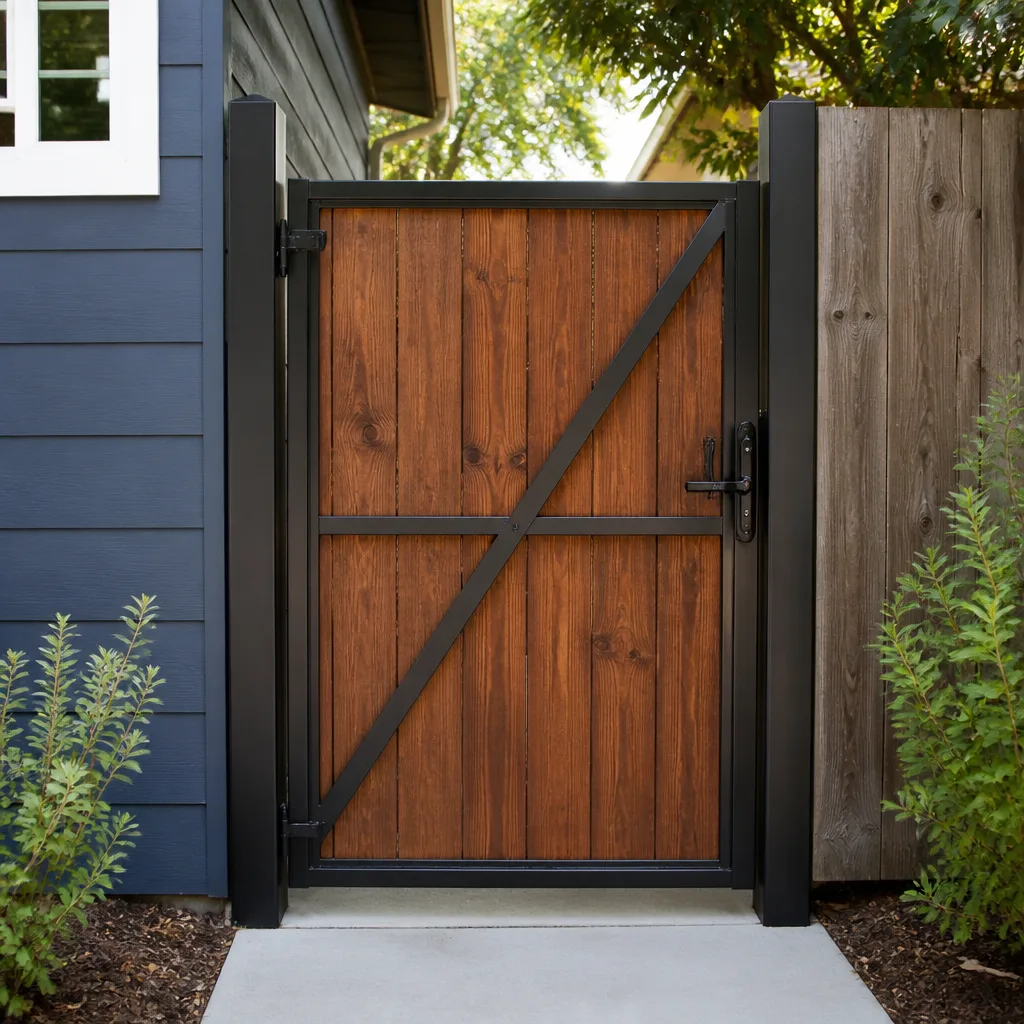 Wood & steel frame
 Farm & ranch
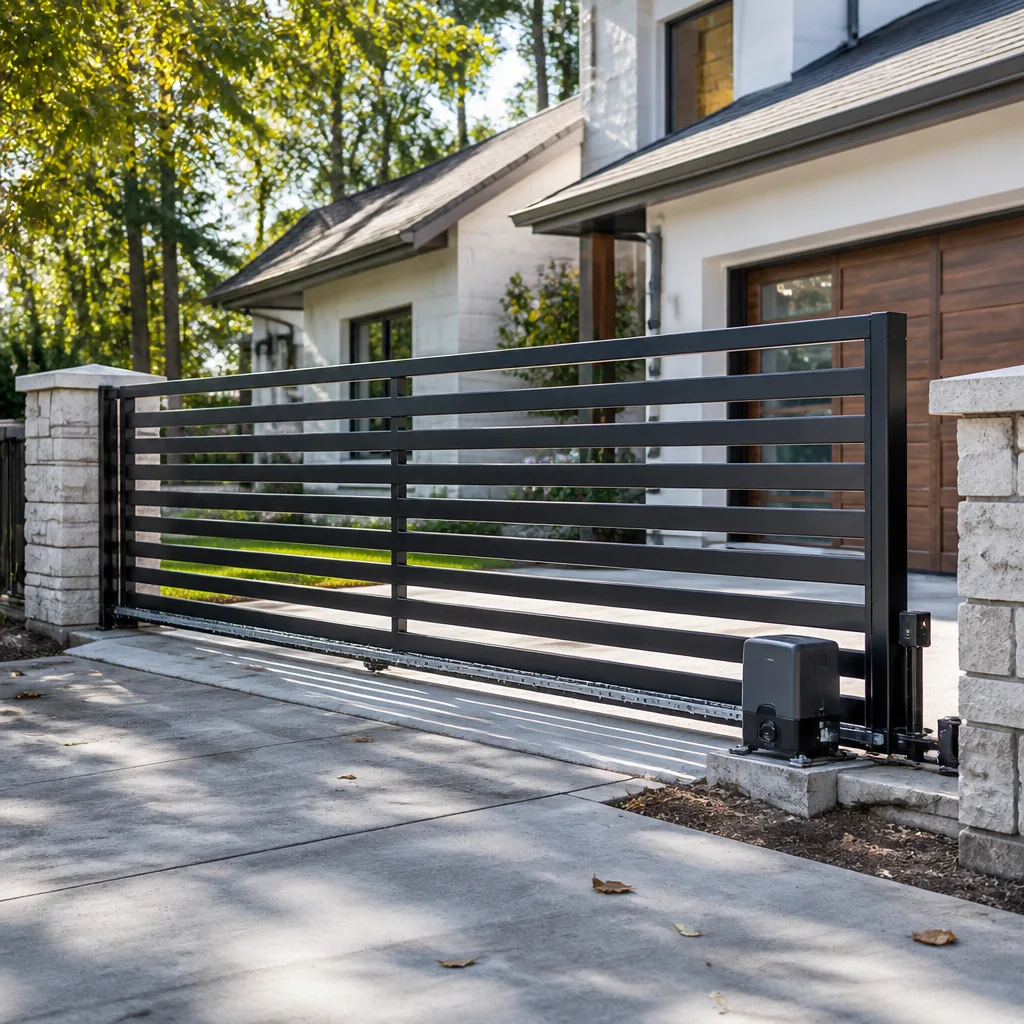 Sliding driveway gates
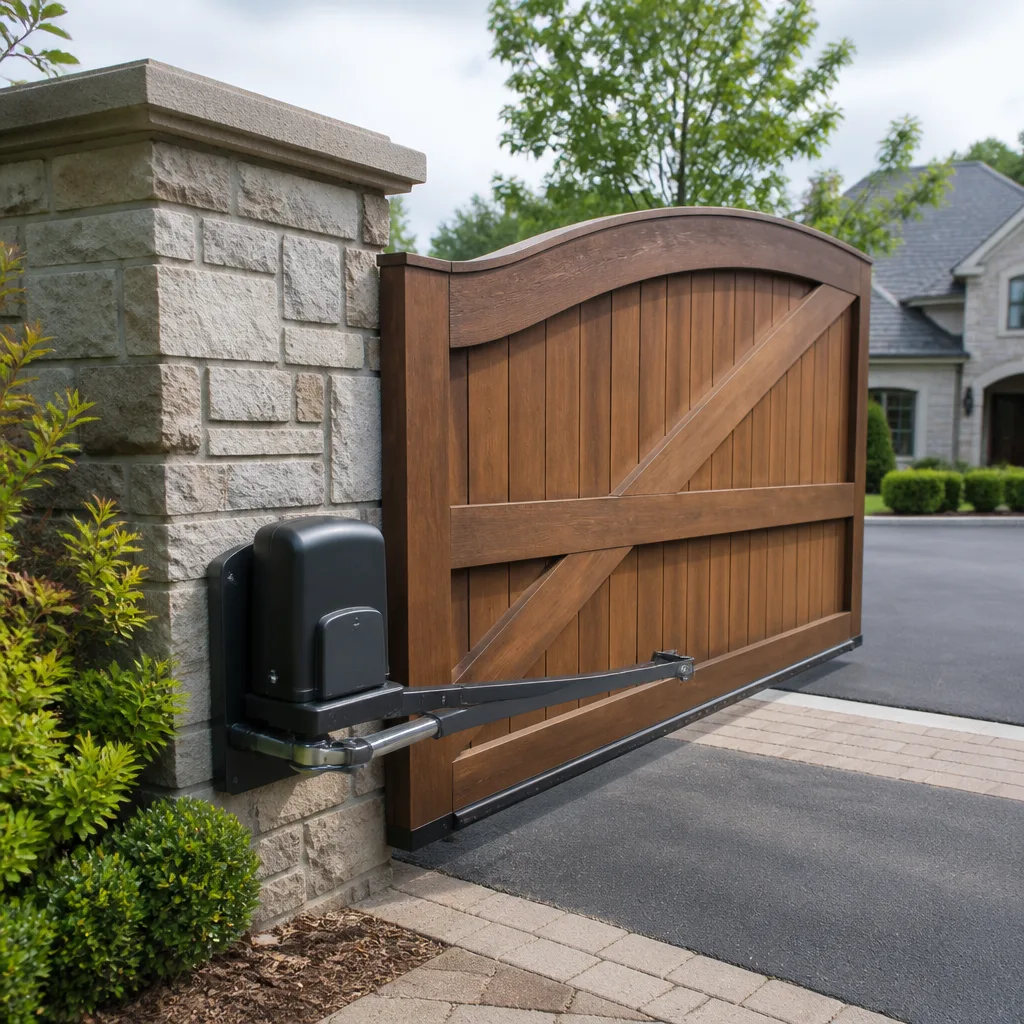 LiftMaster operators
Free on-site gate assessment - hinges, posts, and your LiftMaster or Nice gate operator checked before anything is quoted
The assessment is free and the quote is the invoice.
Get your free estimateDIY vs Professional Gate Repair: What’s Safe to Do Yourself
A gate is one of the heaviest moving objects on your property. It runs on a 120V or 24V operator that talks to safety sensors, limit switches, and in some cases a keypad or home network. Here’s the counterintuitive part: the repairs most people want to attempt are usually the ones that won’t hurt them, and the ones that will bite are the ones that look routine. In our experience across Mesquite, the question was never whether a homeowner is handy. It’s whether you understand what you’re inside of. This guide draws the line at consequence, not difficulty – which jobs are genuinely safe for a careful homeowner, which can void a warranty or create a real danger, and how a $40 afternoon attempt turns into a $600 repair.
What this guide covers
- The five repairs you can do safely, and the one mistake that makes each of them unsafe
- Why self-servicing almost always voids your automation warranty, and what that costs at month 13
- The DIY mistake that causes more secondary damage than any other: improper realignment
- The real cost of a botched attempt, in sequence and in dollars
Quick Answer
Safe for most careful homeowners: tightening hinge bolts, reprogramming a remote or keypad, clearing the track and pivot points of grit, lubricating moving metal, and visual inspection of hinges, welds, and photo-eye alignment. Not safe to attempt yourself: anything inside the control board, limit switch adjustment, weld repair, realignment of a sagging gate, and any work on springs or torsion hardware. A gate can weigh 300 to 900 pounds, and correcting a mistake made in the wrong order often costs three to five times the original repair.
Styles & brands we work with
- Wrought iron
- Wood & steel frame
- Farm & ranch
- Sliding driveway gates
- LiftMaster operators
Table of Contents
- What’s Genuinely Safe to Do Yourself
- The Repairs That Carry Real Risk
- Why Self-Service Voids Most Automation Warranties
- The One DIY Repair That Causes the Most Secondary Damage
- The Five Safe Tasks, Done Correctly
- The Honest Cost Comparison: $40 DIY vs $600 Repair
- Mesquite Conditions That Change the Equation
- When to Call a Professional
What’s Genuinely Safe to Do Yourself
The safe zone for a homeowner is maintenance, not repair. Maintenance means anything that doesn’t require opening a powered enclosure, adjusting a sensor threshold, or moving the geometry of the gate leaf. If a task can be done with a wrench, a rag, a can of approved lubricant, and a remote in your hand, it’s usually within reach. If it requires a multimeter, a ladder, or an angle grinder, it’s not.
Here’s the practical safe list:
- Tightening hinge bolts and cap nuts. Check them every six months. A hinge that rattles under load will eventually wallow out the weld, and that’s a welding job, not a bolt job.
- Reprogramming remotes, keypads, and entry codes. This is user-level work on every brand we service, from Ghost Controls to DoorKing, and the manual is on the manufacturer’s site.
- Clearing the track, pivot, and roller path. Grit, blown sand, and small gravel jam the path and force the motor to work harder than it was designed to.
- Lubricating moving metal. Use what the manufacturer specifies, not whatever’s in the garage. Grease attracts dust; dry lubricant doesn’t.
- Visual inspection. Look at hinge welds, post footings, and the photo-eye light. If the safety beam is misaligned, the gate won’t close reliably – that’s a diagnostic step, not a repair.
None of these require getting inside a powered enclosure, and none of them can shift the load path of the gate. That distinction matters – the moment you change how weight sits on the hinges, you’ve entered the risk zone.
The Repairs That Carry Real Risk
The dangerous list is shorter than the safe list but carries far more consequence. Two things define it: electrical exposure and load-bearing geometry. If a repair touches either one, it belongs to a trained technician.
- Anything inside the control board. The 120V side of a gate operator will hurt you, and capacitor discharge can happen even after the breaker is off. Control board faults also have downstream causes – a bad sensor or a failing motor – that a homeowner can’t diagnose from the board alone.
- Limit switch adjustment. Limit switches tell the gate where to stop. Set them wrong and the gate rams the post, strips the operator gears, or reverses on a person. On a Mesquite property with a heavy steel driveway gate, a mis-set limit can bend the frame.
- Spring and torsion hardware on swing gates. Springs store enormous energy. Messing with them is the leading cause of serious injury in gate work, and no homeowner should be near them.
- Weld repair. A cracked hinge weld is a structural failure, not a cosmetic one. It needs proper prep, penetration, and a post-weld inspection. A cold weld will fail again at the worst moment.
- Realignment of a sagging or dragging gate. We’ll cover this in its own section. It’s the single most expensive DIY mistake we see.
If a repair on this list feels tempting, put the wrench down and get a professional opinion. For repair work in the area, Gate Repair in Mesquite covers the full scope, and estimates are free.
Why Self-Service Voids Most Automation Warranties
Almost every residential gate operator warranty on the market – and this includes every one of the nine brands we service – includes a clause about unauthorized service or modification. Open the housing to swap a board yourself and the manufacturer can decline the claim. That’s not a scare tactic; it’s the standard language.
Here’s what that costs. A typical residential gate operator runs several hundred to over a thousand dollars for the unit alone, before installation. If your motor fails at month 13 and the warranty would have covered it, you’re now paying full price for the replacement, the labor, and possibly a reinstall of accessories. The savings from a $40 DIY attempt vanish inside five minutes of a warranty denial.
Two things to check before you so much as remove a screw:
- Read the warranty terms for your specific operator. Look for the words “unauthorized service,” “modification,” and “non-approved parts.” Those are the trigger clauses.
- Keep records of any professional service. A documented repair by a trained tech keeps the warranty whole. A self-serviced component does the opposite.
When a motor or opener needs attention, Gate Motor & Opener in Mesquite explains what a proper service looks like. If you’ve got a written estimate from someone else, a free second opinion is always available.
The One DIY Repair That Causes the Most Secondary Damage
If we could remove one repair from the internet, it would be “fix a sagging gate” videos. Realignment is the mistake that costs homeowners the most, in our experience, because it’s the one that looks easiest.
Here’s the trap. A gate that drags at the bottom or hits the post is usually a symptom of a shifted hinge, a settled footing, or a bent frame. If you loosen the hinge bolts and shove the gate back into position, you’ve moved the symptom, not the cause. The gate now hangs wrong, which throws load onto the operator arm, which makes the motor work harder than it was built for. Within a season you’re replacing the motor, not adjusting the hinge.
The secondary damage we see in Mesquite most often:
- Premature motor failure. A gate that no longer swings freely forces the operator to fight gravity. Motors aren’t built for that.
- Stripped hinge threads or cracked welds from over-tightening during the “fix.”
- Misaligned photo-eyes after the gate leaf moved, causing the gate to refuse to close or to reverse unexpectedly.
- A bent operator arm when a realigned gate rises through the arc the arm was set for.
Realignment done right starts with finding why the gate moved. That’s a diagnostic, on-site job. If your gate has started to drag or sag, don’t start with the wrench. Start with a call.
The Five Safe Tasks, Done Correctly
Here’s how to do each of the five safe repairs the right way, and the specific mistake that turns each one into an expensive problem.
- Tighten hinge bolts. Use the correct size wrench, snug rather than crank. Check every hinge, top and bottom. The mistake: over-tightening a cap nut until it strips the thread or cracks the weld collar, turning a 30-second job into a welding repair.
- Reprogram a remote or keypad. Find the manual for your exact model on the manufacturer’s site (the brand name is on the operator housing). Follow the program sequence once, carefully. The mistake: mashing buttons in hopes one works, which can leave the receiver in an unknown state and lock out all other remotes. It also risks wiping a shared code your family depends on.
- Clear the track and pivot path. Brush out grit, blown sand, and small gravel along the travel path. Sweep the ground where the gate swings. The mistake: aiming a pressure washer at the pivot or into the operator housing – water in a control board is a permanent failure.
- Lubricate moving metal. Use the manufacturer’s specified lubricant on hinges, pivots, and rollers. Wipe off excess. The mistake: using a heavy grease that traps Mesquite dust and turns into an abrasive paste, wearing the joint faster than dry metal would have.
- Inspect the safety photo-eye. Confirm the sensor lens is clean and the beam lines up with its reflector. Watch for the LED indicator. The mistake: nudging the sensor bracket to “fix” a false trigger. Once the sensor is out of alignment, the gate can reverse on a person, and that’s a call-out.
The Honest Cost Comparison: $40 DIY vs $600 Repair
Let’s be blunt about the math. A DIY attempt isn’t always cheaper than a professional repair – it’s cheaper only when it works. Here’s what a typical homeowner spends in Mesquite when a repair goes wrong, in sequence.
The do-it-yourself attempt:
- Parts and tools: $40 to $80
- Time: an afternoon
- Result: some fixes work, many don’t
When it fails:
- Original repair cost: unchanged, still needed – $150 to $300
- Added damage: motor strain or bent operator arm – $200 to $400
- Warranty impact: potentially voids a motor replacement worth $400 to $800
- Total: $550 to $900 for a job that started as a $40 problem
We’re not saying every small repair is the wrong call. We’re saying the order matters. Five dollars of wrenching on a hinge bolt is fine. Five dollars of wrenching to “fix” a sagging gate turns a hinge adjustment into a motor replacement. Upfront pricing on the professional repair is settled before a single bolt is turned. On a repair over $250, there’s $50 off – so the gap between a smart attempt and a proper repair is often smaller than it looks.
Mesquite Conditions That Change the Equation
Mesquite has its own patterns, and they’re relevant to which repairs you should consider. Wind-borne sand gets into every pivot and track. Summer heat makes the metal and the motor work harder. Winter cold swings are short but can crack a hinge weld that’s been quietly fatiguing since spring.
The specific conditions we see in Mesquite neighborhoods:
- Sand and grit infiltration. Driveway gate pivots in Mesquite fill with fine sand faster than in wetter climates. That’s a maintenance issue – clear it seasonally. It’s not a repair.
- Heat-cycled metal. Steel expands and contracts across the summer-winter swing. Small cracks appear in hinge welds near the post footing. Catch them in a visual inspection and they’re minor. Ignore them and they’re a welding job.
- Double gates under load. Larger gates in the Mesa Boulevard corridor or along Sun City Mesquite carry more weight on fewer hinges. A hinge bolt that’s a minor tune-up on a small gate is a load-bearing concern on a large one.
- Seasonal timing. The $89 Seasonal Tune-Up exists precisely for the shoulder seasons, when a small adjustment prevents the spring failure that becomes a summer emergency.
None of these are reasons to panic. They’re reasons to inspect. If you’re not sure what you’re looking at, Gate Installation in Mesquite shows what a properly installed gate looks like – a good comparison point for assessing your own.
Common Mistakes to Avoid
- Starting with the wrench on a sagging gate. Loosening hinges and shoving the gate back into place moves the symptom and shifts the load onto the motor. Realignment starts with a diagnosis, not a bolt.
- Opening the control board “just to look.” The 120V side of a gate operator is a genuine shock hazard, and opening the housing is exactly what voids a warranty. If the operator misbehaves, that’s a call, not a peek.
- Adjusting limit switches by trial and error. A mis-set limit strips operator gears and can drive the gate into the post. On a Mesquite steel gate, a bend from a mis-set limit is often a fabrication job.
- Using the wrong lubricant. Heavy grease traps blown sand and grinds the joint loose. Use what the manufacturer specifies and wipe off the excess.
- Pressure-washing near the operator or pivot. Water in a control board is a permanent loss. Keep the hose pointed at the gate leaf only.
- Ignoring a photo-eye that “works anyway.” A safety beam that’s intermittently blocked is a hazard, not a nuisance. Reversing on a person is the exact failure the sensor is designed to prevent.
- Assuming a small issue can wait until next season. In Mesquite, a hinge that rattles in March is a welding job by August. The inspection is free with any service call.
When to Call a Professional
Call a professional if the repair involves anything inside the operator housing, a limit switch, a weld, spring, or hinge on a gate that sags or drags, realignment of the gate leaf, or any electrical work. Call us sooner if the gate has stopped closing reliably, the operator runs but the gate doesn’t move, or a photo-eye light is out. Those are the symptoms that turn a $150 repair into a $600 one if left alone. We’ve seen all of them in Mesquite, and we’d rather see them early than late. Ironworks Gate Co. Mesquite offers free estimates in Mesquite – call (844) 797-2573. A live person answers, 24 hours a day, 7 days a week.
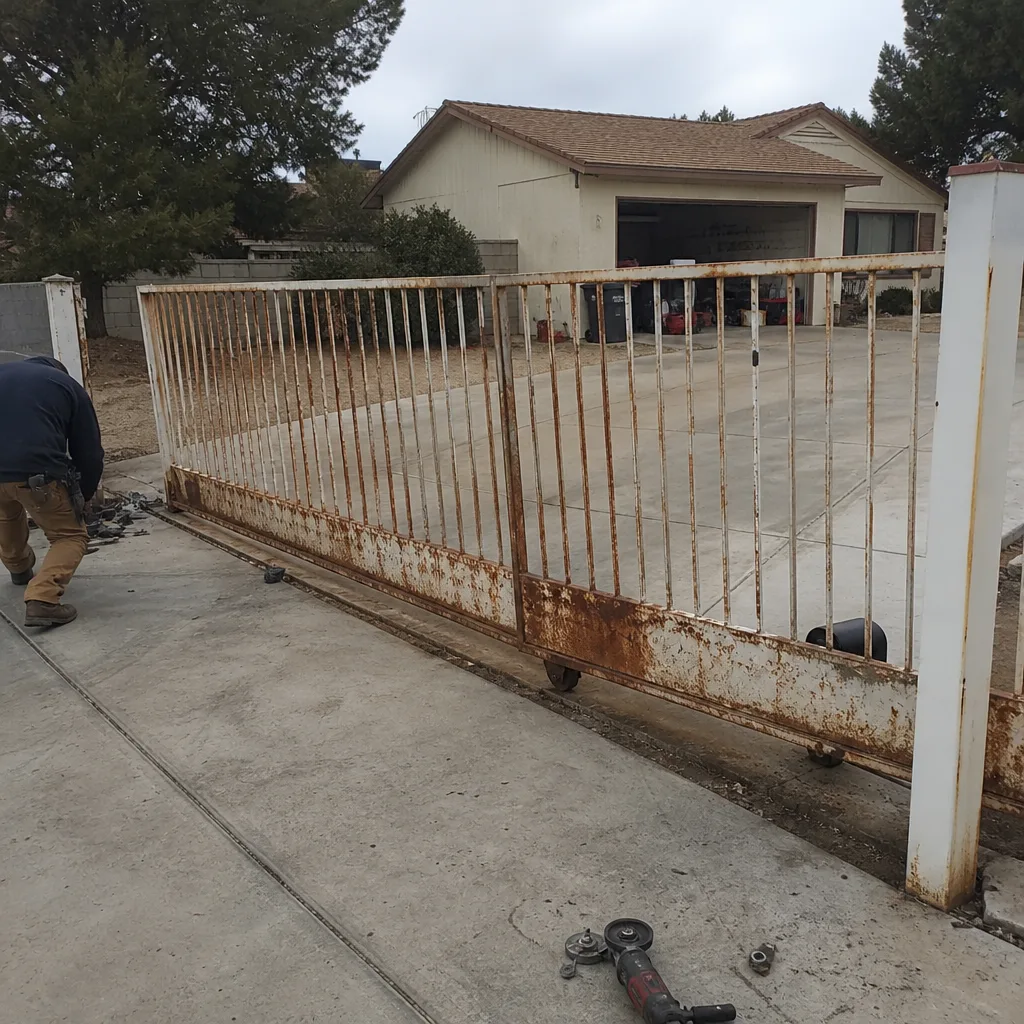
See the difference
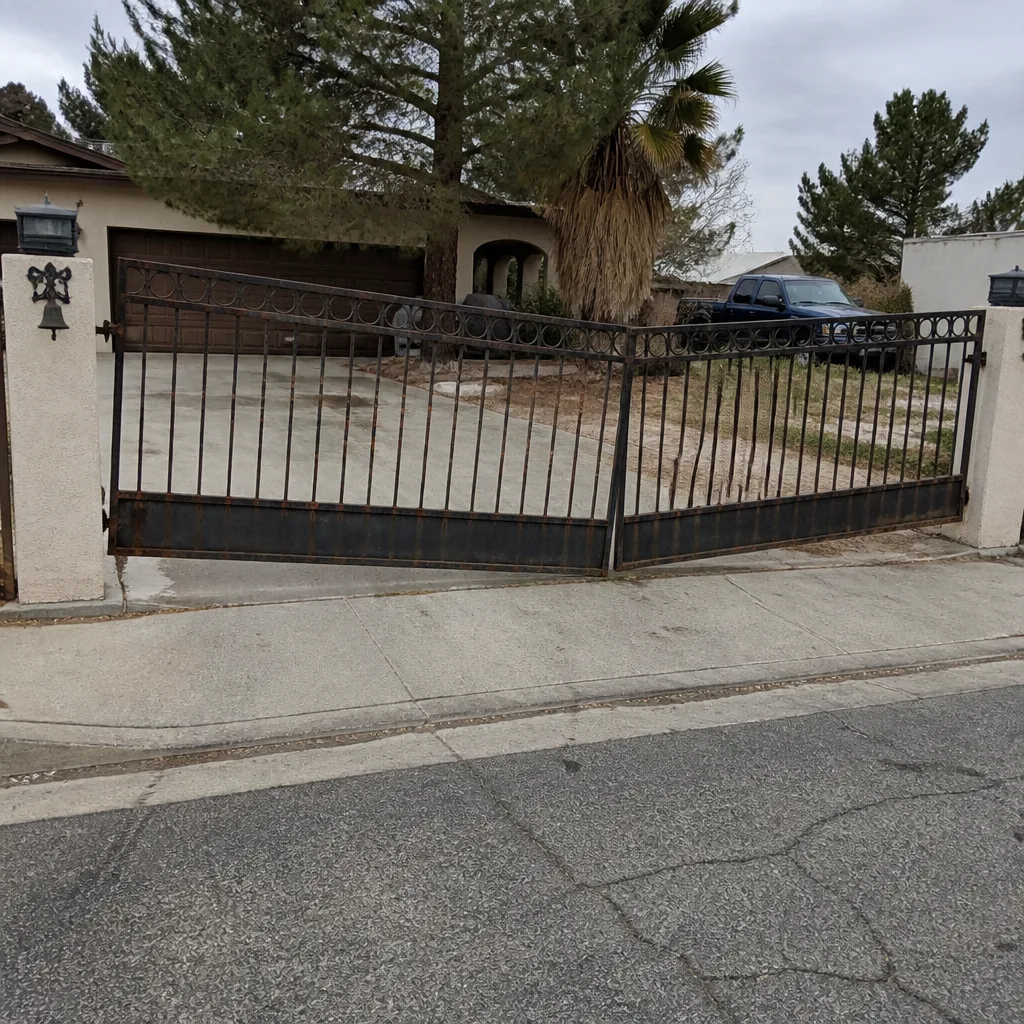 Before
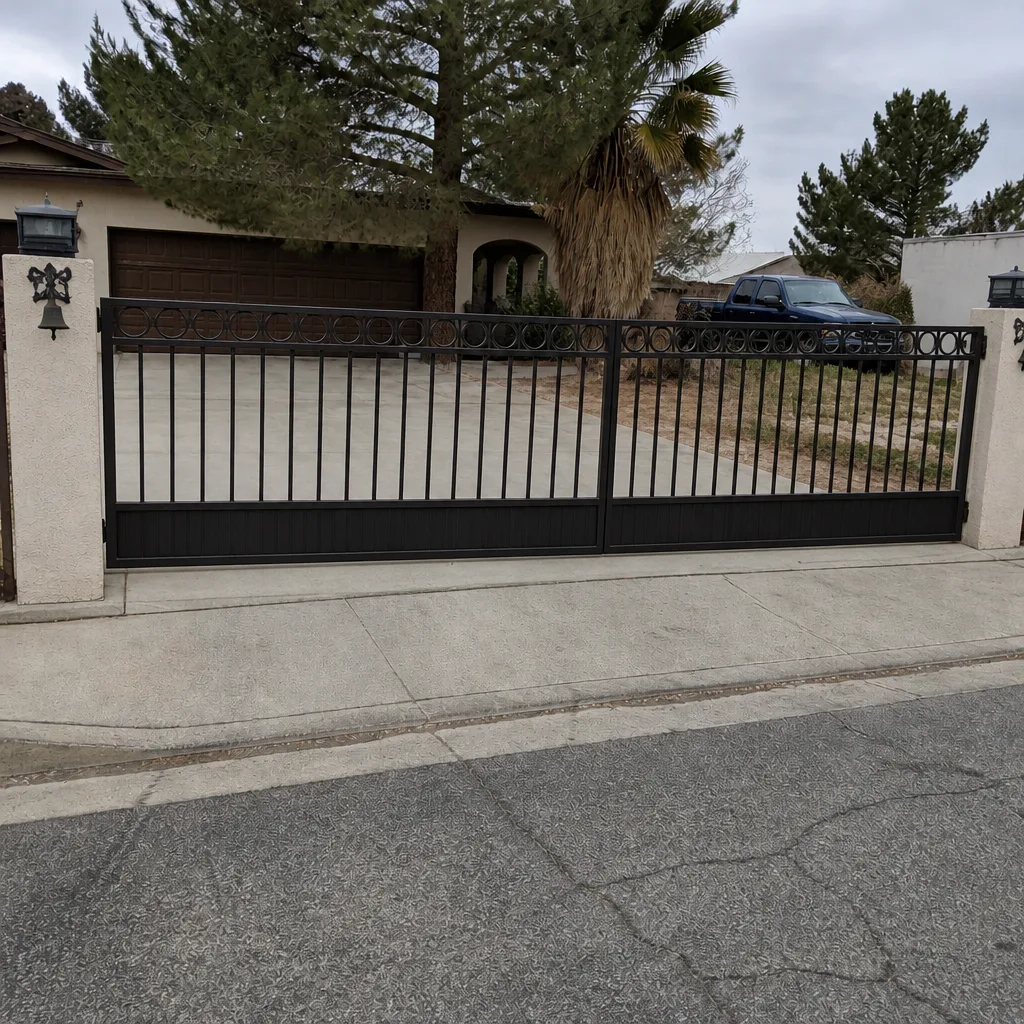 After
 Before
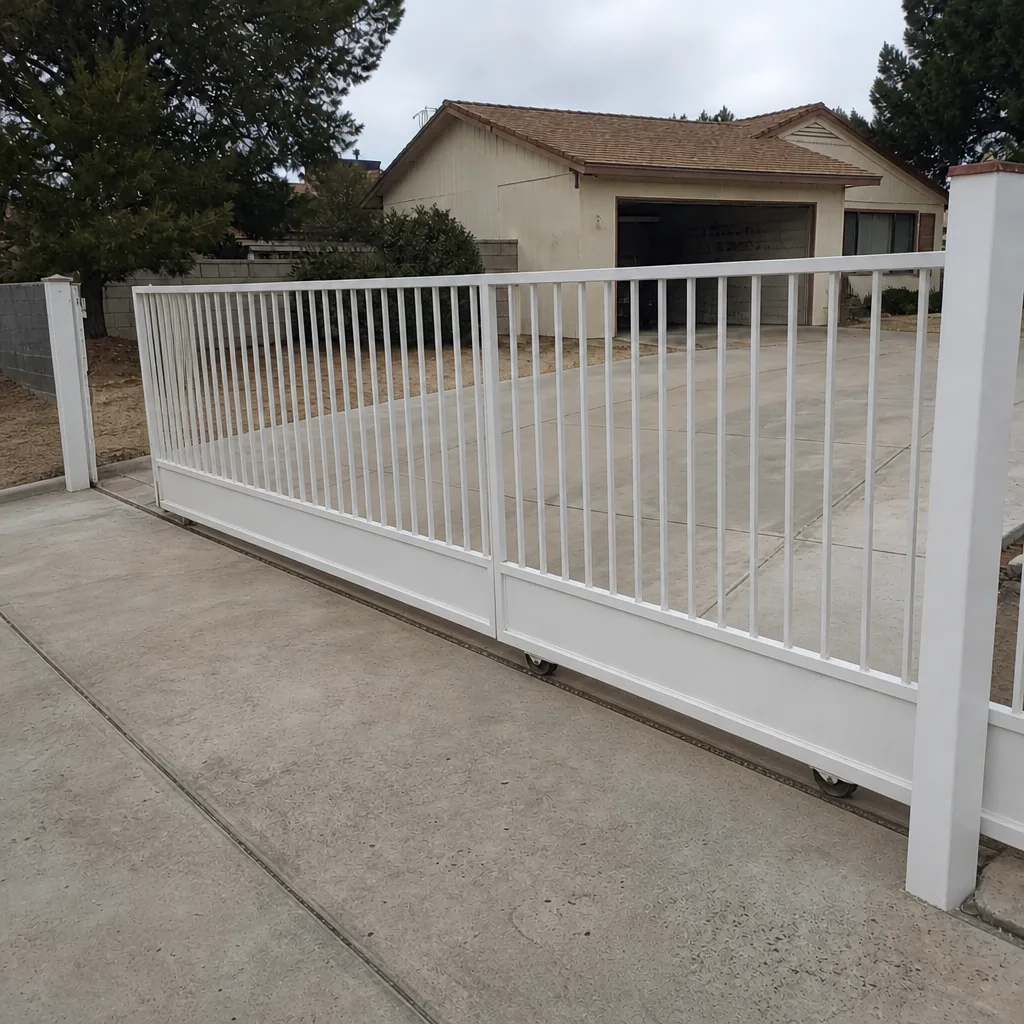 After
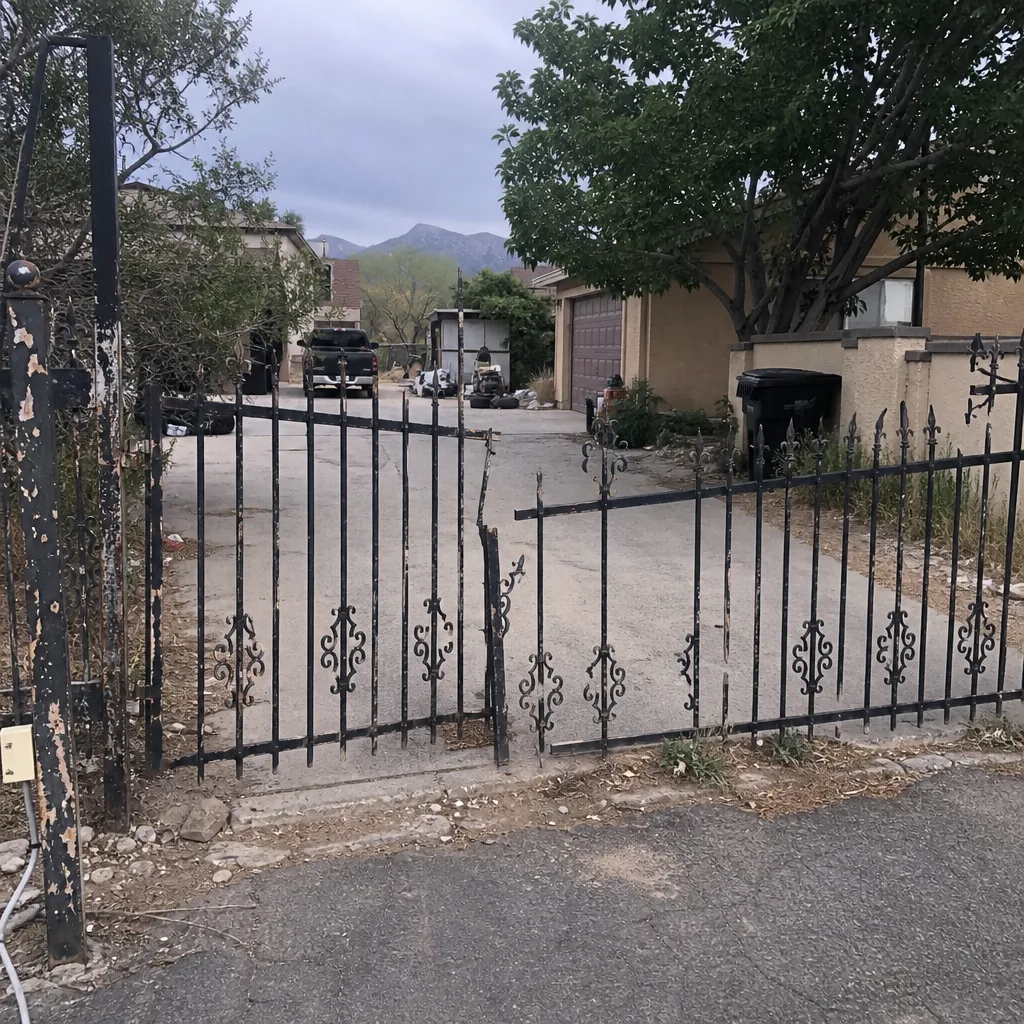 Before
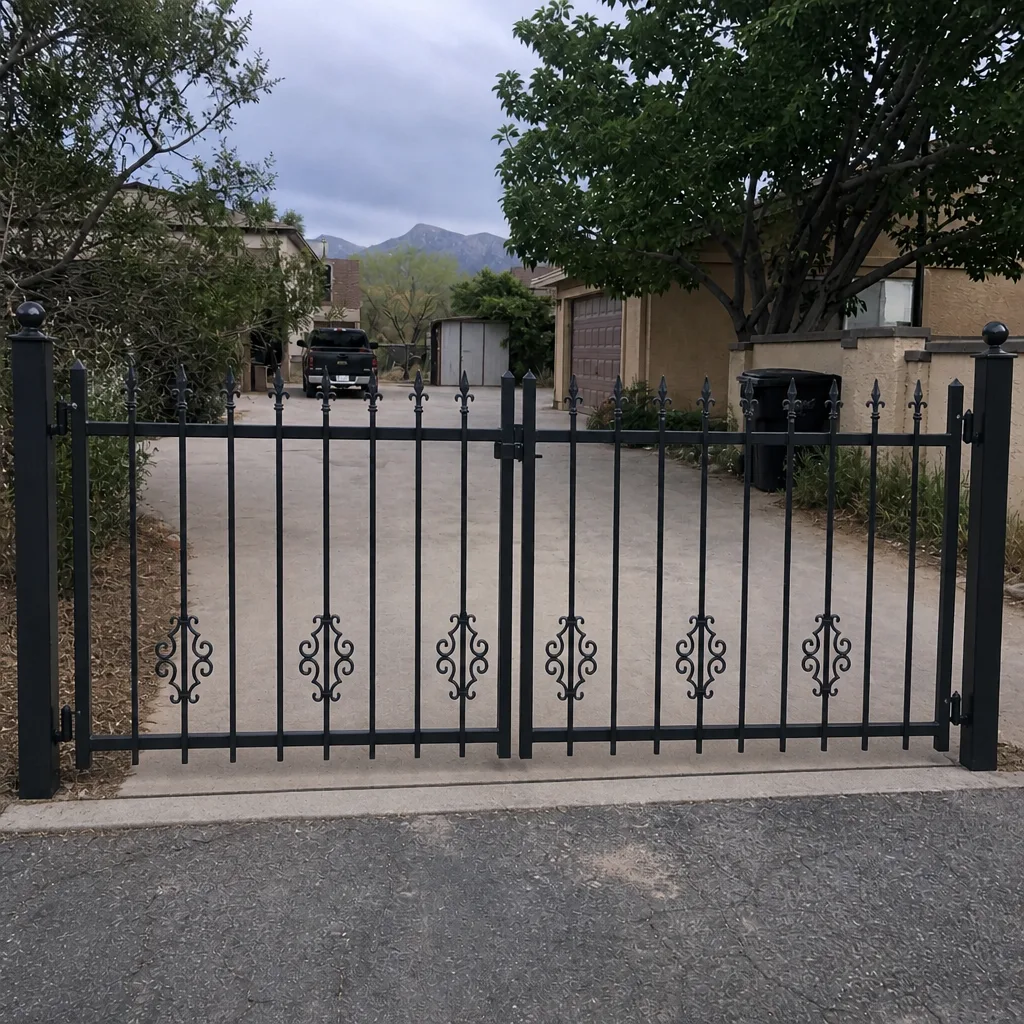 After
Frequently Asked Questions
No – limit switch adjustment is a professional task. The limit tells the gate where to stop; set it wrong and the gate can ram the post, strip the operator gears, or reverse on a person. On a heavy steel gate, a mis-set limit can also bend the frame, which turns a $200 adjustment into a $700 fabrication job. Call (844) 797-2573 for a quote, and estimates are free.
No. Reprogramming remotes, keypads, and entry codes is user-level work on every brand we service, including Ghost Controls and DoorKing. What voids a warranty is opening the operator housing or swapping internal components yourself. If you’re not sure whether a repair crosses that line, call us and we’ll tell you – no charge.
Tightening the hinges often makes it worse. A sagging gate moved because of a shifted hinge, settled footing, or bent frame, and tightening without diagnosing the cause shifts load onto the motor. In our experience this is the DIY mistake that causes the most secondary damage – a $40 afternoon fix becomes a $600 motor or weld repair. Call (844) 797-2573 before you reach for the wrench.
Most residential gate repairs in Mesquite run $150 to $350, with welding and motor issues at the higher end. Every job is quoted upfront and agreed before any work starts, so there are no surprises on the bill. Repairs over $250 take $50 off the standing offer, and senior and veteran discounts are always 5%. Call (844) 797-2573 for an exact quote – estimates are free.
Check hinge welds for cracks, hinge bolts for looseness, post footings for movement, and the photo-eye light for a clean beam. Grit and sand blown into the pivot path is a maintenance issue; a cracked weld or a shifted post is a repair. If you can’t tell the difference, we’ll take a look – call our team at (844) 797-2573.
Yes – we’re trained and equipped on nine major gate-automation brands, including Ghost Controls, DoorKing, Elite, and Mighty Mule. Whatever is on your driveway, we make the correct fix on the first visit, in most cases. Every job is protected by the 90-Day Done Right Promise in writing. Call (844) 797-2573 for a free estimate and we’ll confirm the specific model before we schedule.
The Bottom Line
The DIY versus professional question isn’t about how handy you are. It’s about consequence. Tighten hinge bolts, reprogram a remote, clear the track, lubricate moving metal, and inspect the safety beam – those five are safe and worth doing. Anything inside the control board, any limit switch, any weld, any spring, and any realignment belongs to a trained technician. The math isn’t close: a $40 DIY attempt in the wrong order becomes a $600 professional repair, and it can void a warranty worth several hundred more. When in doubt, get the free estimate before you pick up the wrench.
Contact
If you’re not sure whether a repair on your gate falls on the safe side of the line, call us. Ironworks Gate Co. Mesquite will walk you through it, give you a straight answer, and quote the job upfront before any work begins. Call (844) 797-2573 for a free estimate – a live person answers 24 hours a day, 7 days a week. Every completed job is backed in writing by the 90-Day Done Right Promise. If it’s not right, we come back and make it right. For new gates and automation, we measure, order, and schedule properly – and we’ll always be there when we say. Start with Ironworks Gate Co. Mesquite home to see the full scope of what we do.
Written by the team at Ironworks Gate Co. Mesquite.