
Last updated November 17, 2026
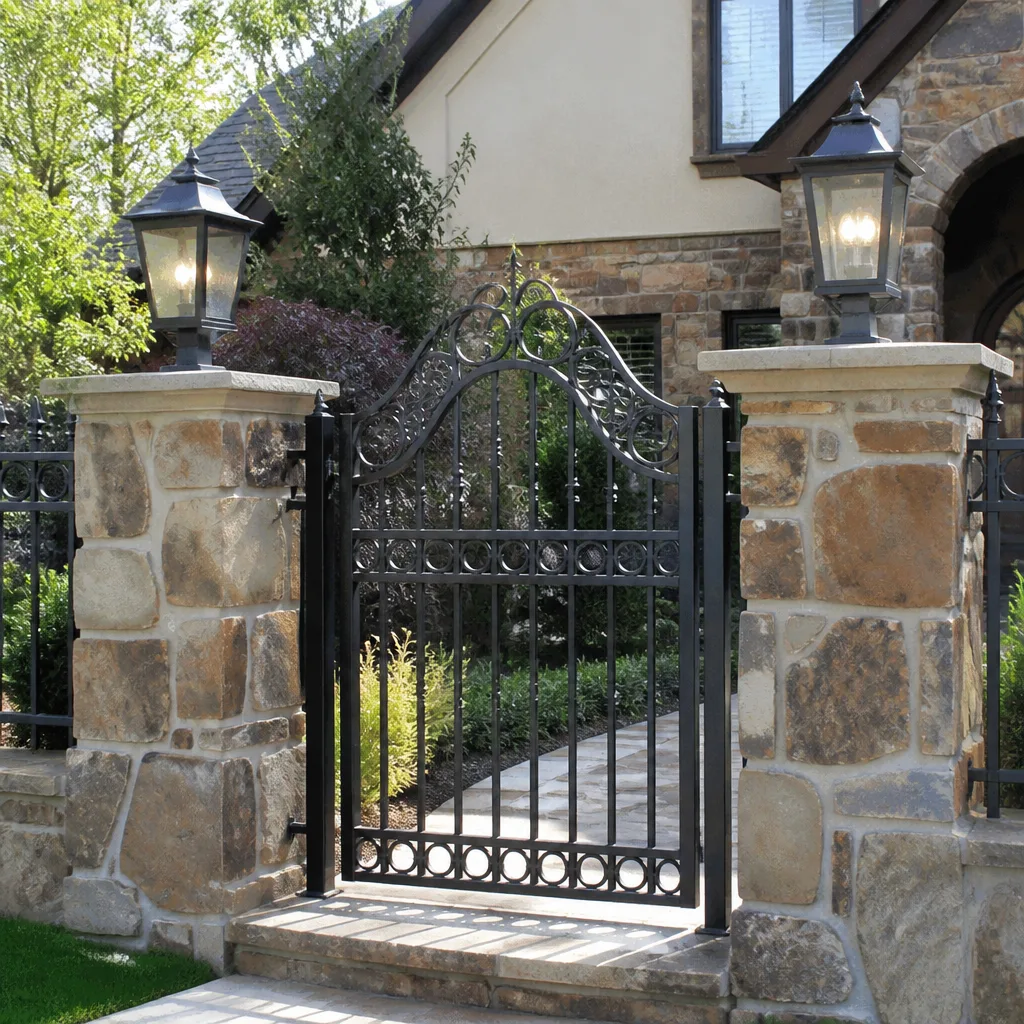 Wrought iron
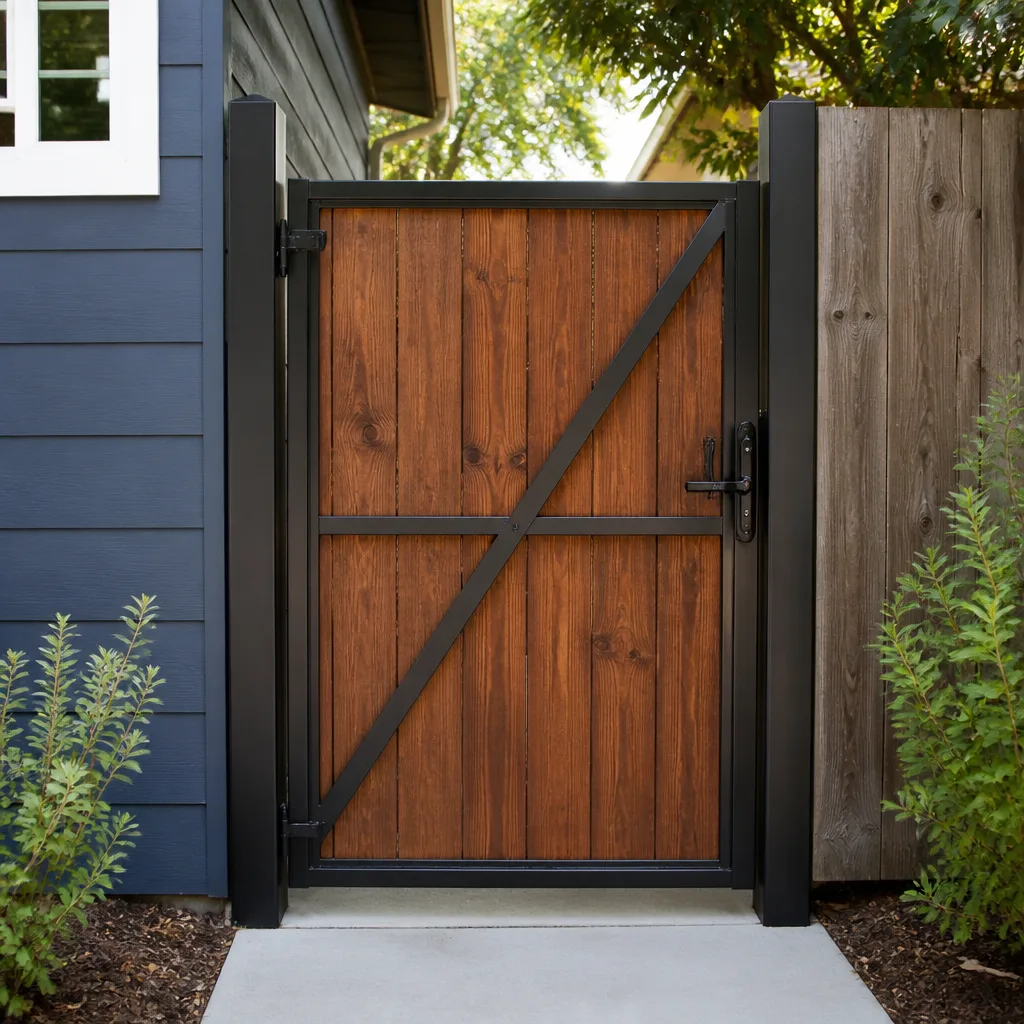 Wood & steel frame
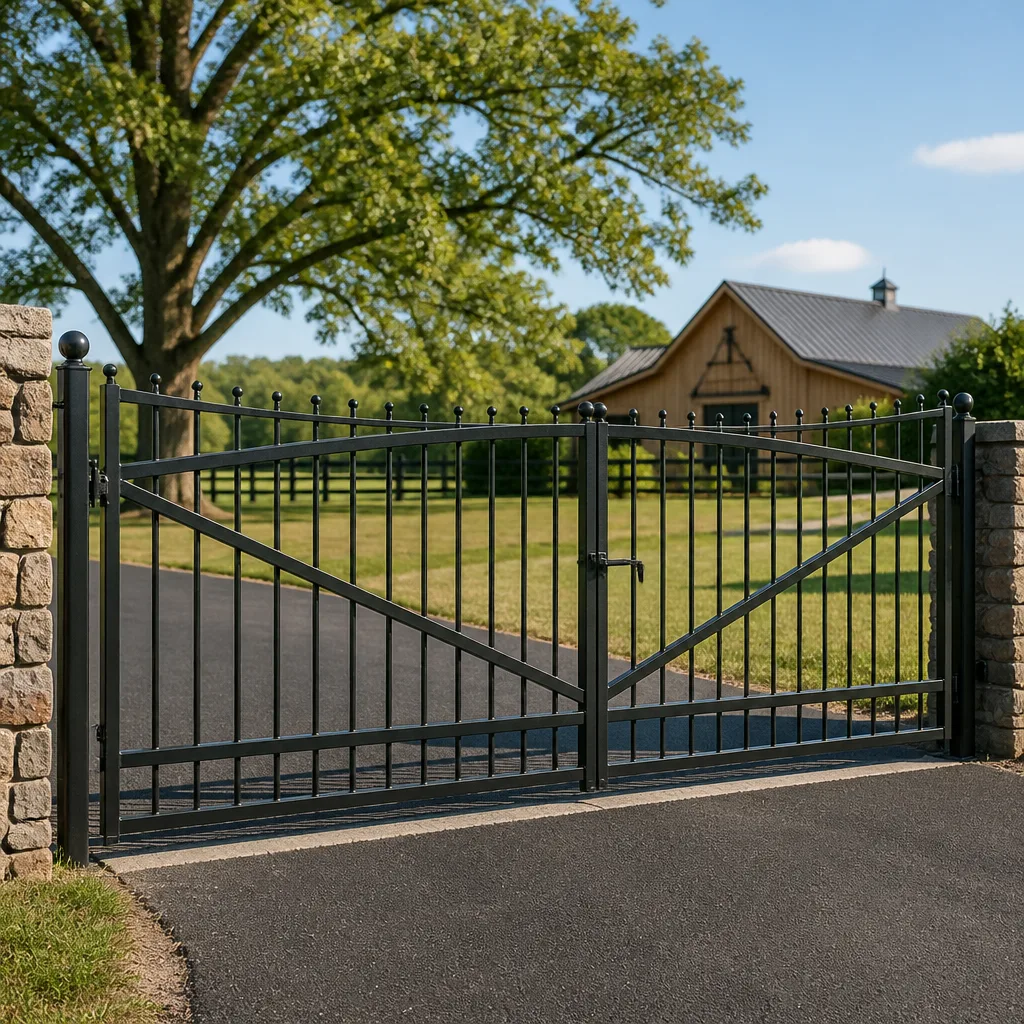 Farm & ranch
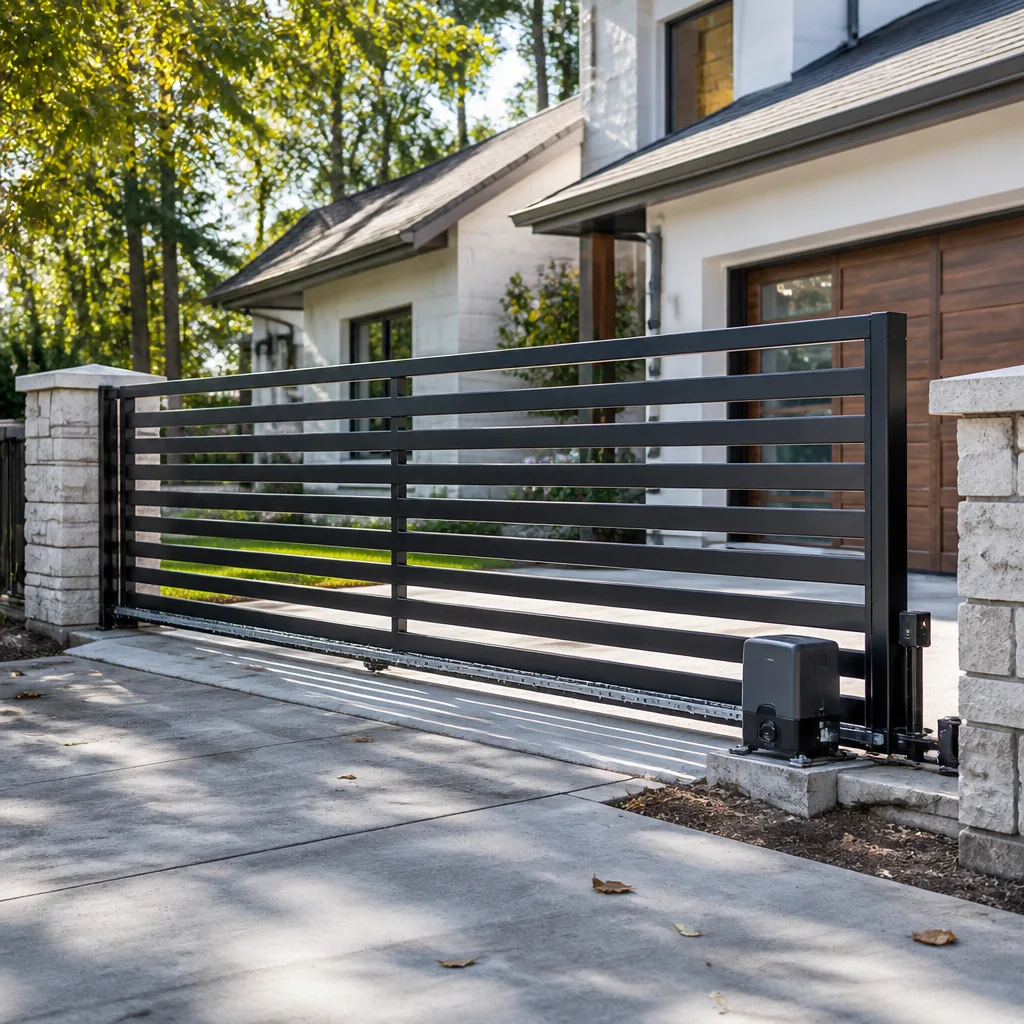 Sliding driveway gates
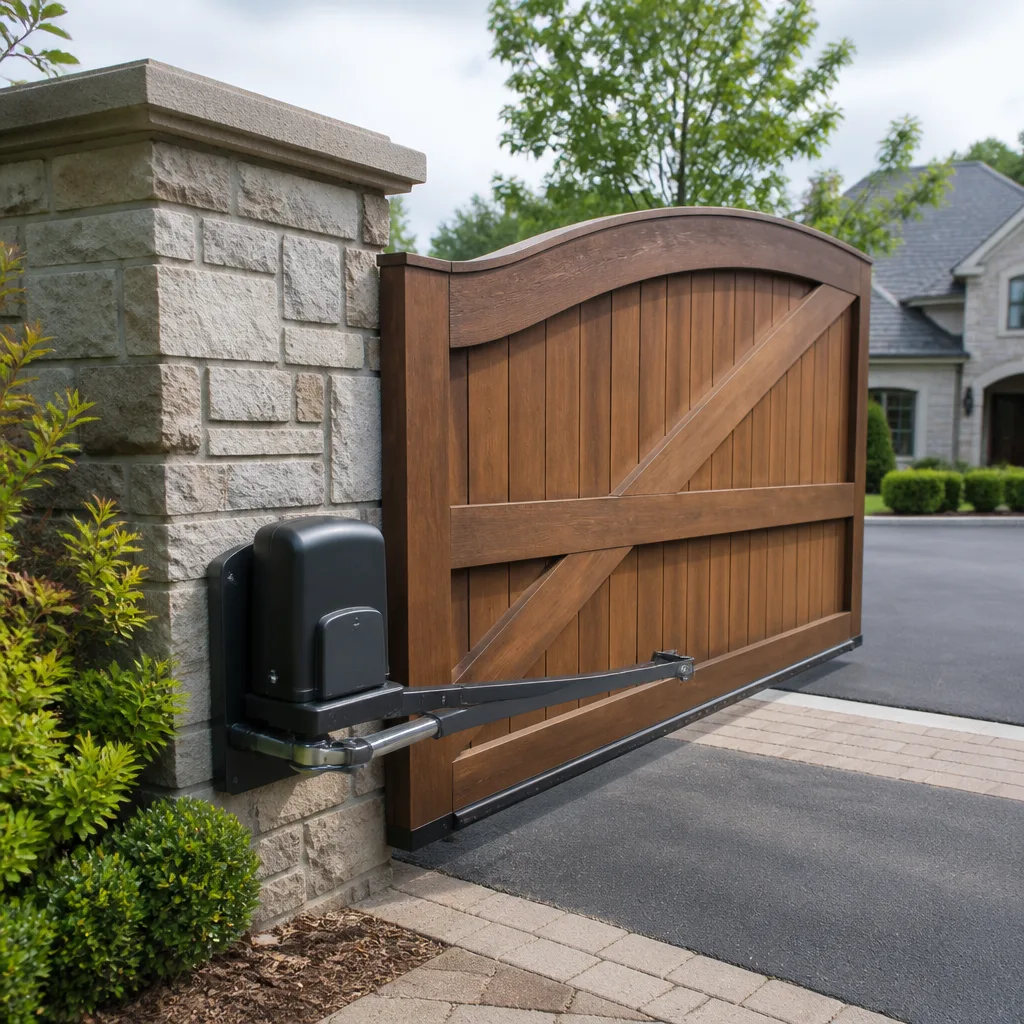 LiftMaster operators
Free on-site gate assessment - hinges, posts, and your LiftMaster or Nice gate operator checked before anything is quoted
The assessment is free and the quote is the invoice.
Get your free estimateThe Complete Gate Parts & Welding Guide for Mesquite Homeowners
A weld that holds for twenty years in Portland can crack in four here. Not because it was done wrong, but because nobody accounted for a 90-degree daily temperature swing working a mild steel joint 365 days a year. Mesquite is hard on metal in ways that coastal and Midwest guides never address. Alkaline soil eats post steel from below. UV grinds coatings down from above. Between the two, a gate that looks fine can be two summers from a hinge failure. This guide covers the parts that fail first, how to spec metal for our conditions, how to read a welding bid, and when to stop patching. Everything here is written for this town, from people who work in it.
Quick Answer
Gate parts and welding in Mesquite should be specified for high-desert conditions: alkaline, caliche-heavy soil below grade, intense UV above grade, and daily thermal swings that stress welds and bind hinges. The parts that fail first are hinges, rollers, latches, and coating systems, not usually the gate frame. Get the metal spec, coating, and weld process right the first time and a gate here lasts decades. Get them wrong and you’ll be re-welding every few years.
Styles & brands we work with
- Wrought iron
- Wood & steel frame
- Farm & ranch
- Sliding driveway gates
- LiftMaster operators
Table of Contents
- How Mesquite’s Soil and Caliche Attack Gate Posts
- The Gate Hardware That Fails First in the Desert
- Thermal Expansion and Gate Geometry: Why Gates Bind in Summer
- Decorative Iron vs. Structural Tube Steel vs. Ornamental Aluminum
- How to Read a Welding Bid: A Plain-Language Glossary
- Repair or Replace: Making the Call on an Aging Gate
- Sourcing Parts: What’s Actually Available and What Isn’t
- Coating Systems That Survive Mesquite’s Sun
How Mesquite’s Soil and Caliche Attack Gate Posts
Below-grade steel in Mesquite lives in a hostile environment. The soil here runs alkaline, often with a caliche layer that traps moisture against the metal in pockets, and that trapped moisture plus the mineral content accelerates corrosion at the soil line. That’s where most post failures start: right at grade, where you can’t see it until the post is already compromised.
What actually resists this:
- Hot-dipped galvanized posts, not painted steel. The zinc coating on hot-dip galvanizing is sacrificial and thick enough to survive decades of alkaline exposure. Painted mild steel posts rust through at the weld line in a fraction of that time.
- Concrete footings that drain. A post set in a concrete plug with no drainage holds water against the steel. Slope the top of the footing away from the post and keep the steel clear of standing water.
- Coating the below-grade section with a bituminous or epoxy barrier. This is cheap insurance and rarely done by outfits that just dig a hole and drop a post in.
- Keeping the weld beads above grade. Field welds at the base of a post are the first thing to go. Spec a post long enough that the join is well clear of the soil.
In our experience, caliche doesn’t just corrode – it also makes setting posts harder than homeowners expect. Digging through a caliche layer means different footing methods, and a crew that hasn’t worked in this ground will either cut corners or come back with a change order. When we quote post work in Mesquite, the soil conditions are part of the price from the start.
The Gate Hardware That Fails First in the Desert
Homeowners often assume the gate frame is the weak point. It usually isn’t. In high heat and relentless UV, the small hardware dies first, and that’s what drives most repair calls in Mesquite.
- Hinges: Grease cooks off in summer heat, then grit gets in and the hinge wears oval. Expect 5 to 10 years on a quality hinge before it needs replacement; cheaper hardware can go in 3.
- Rollers and track wheels: UV makes nylon and cheap urethane brittle. Sealed steel or high-grade polymer rollers last longer here than the standard hardware-store wheels, which can fail inside two or three summers.
- Latches and catches: Springs lose tension faster in heat, and plastic components crack under UV. A latch that worked smoothly last spring often sticks or won’t catch by August.
- Coating and paint: UV breaks down paint and powder coat from the top surfaces first. Once the coating fails, the metal underneath starts to pit, and pitting concentrates at welds and edges.
- Operator and motor components: Seals, belts, and control boards age faster in extreme heat. This is where gate motor & opener service in Mesquite becomes its own discipline, separate from metal work.
A smart maintenance schedule rotates these replacement intervals so you’re not replacing everything at once. An annual gate repair inspection that checks hinge wear, roller condition, and coating before summer is cheaper than a mid-summer breakdown.
Thermal Expansion and Gate Geometry: Why Gates Bind in Summer
Steel expands when it heats and contracts when it cools. On a 20-foot gate, a 90-degree daily swing can move the frame enough to close up the clearances you designed into it in the cooler hours. That’s why a gate that swings freely at 6 a.m. can drag by 3 p.m.
Getting the geometry right is the fix, and it has to be done at spec time:
- Spec for the hottest condition, not the average. Hinge placement and clearances should be calculated for the gate’s expanded length, not its cool-morning length.
- Leave more hinge-side clearance than feels necessary. A quarter inch of extra gap at the hinge side looks sloppy on paper but prevents binding when the gate grows in the sun.
- Anchor the hinge post deep enough. The post itself moves with thermal cycling, and a shallow post shifts more than a deep one. In caliche-heavy ground, footing depth is not optional.
- Use hinges designed for adjustment. Adjustable hinges let a technician dial in the gate after install and again after the first summer, when the real movement shows up.
If a gate is already binding every summer, don’t force it. A binding gate puts extra load on hinges, the operator, and the frame, and it will eventually crack a weld. Thermal binding is one of the most common things we address when we’re called out on what looks like a motor problem but is actually a geometry problem. If the motor is driving a jammed gate, the motor is the victim, not the cause.
Decorative Iron vs. Structural Tube Steel vs. Ornamental Aluminum
You’ll hear these three terms in almost every gate bid, and they mean very different things. A company that quotes “iron” without saying which of these they mean is telling you something about how carefully they build.
- Decorative iron (wrought or cast): Real wrought iron is rare today. What’s usually sold as “decorative iron” is mild steel or cast iron formed into ornament. It’s strong and repairable, but it rusts if coatings fail, which is a real risk here. Best for front entry and estate gates where a welder can maintain and re-coat the joints.
- Structural tube steel: Square or rectangular tubing with walls from 1/8-inch to 1/4-inch thick, welded into a frame. This is the right choice for a driveway gate that carries weight, gets hit by a motor, and has to hold geometry across thermal swings. The wall thickness is the spec that matters – a 1/8-inch wall and a 3/16-inch wall look identical from outside and behave very differently.
- Ornamental aluminum: Light, rust-proof, and low-maintenance. It won’t rust in Mesquite’s alkaline soil, which is a real advantage. But aluminum is softer than steel, flexes more, and welds differently – it won’t take the same structural demands as tube steel on a heavy driveway gate. It’s often the right call for a fence or a lighter decorative gate, less so for a large swinging driveway gate.
For a driveway gate in Mesquite, we most often spec structural tube steel with a properly applied coating. For a walkway gate or a purely decorative panel, aluminum is often the better material. The right answer depends on what the gate has to do, not on which metal sounds more premium.
How to Read a Welding Bid: A Plain-Language Glossary
Welding bids are full of terms that decide how long the work lasts. Here’s what they mean, so you can compare two quotes honestly.
- MIG welding (GMAW): Wire-fed welding that’s fast and clean. Common for gate frames. It’s a perfectly sound process when done correctly on clean metal.
- TIG welding (GTAW): Slower, more precise, and better on thin material and aluminum. If a bid specifies TIG on a gate with a lot of visible joints, that’s a sign of a careful build.
- Stick welding (SMAW): Older, rugged process often used outdoors. Fine for structural joins but produces more spatter and is harder to finish cleanly.
- Bead: The raised line of weld metal. A good bead is uniform and even. A lumpy or undersized bead is a warning sign.
- Weld penetration: How deep the weld fuses into the base metal. Shallow penetration is the number one cause of weld failure, and it’s invisible once the joint is painted.
- Post-weld treatment: Grinding, priming, and coating the weld. Steel that’s welded and immediately painted without this step will rust at the weld line. Always ask.
- Fabrication tolerance: How much the finished gate is allowed to be out of square. A good shop holds tight tolerance; a loose tolerance is how you end up with a gate that binds.
A bid that lists the process, the metal spec, wall thickness, coating, and post-weld treatment is a bid you can compare. A one-line bid is not. Our gate installation in Mesquite quotes are written so you can see each of these, and any written estimate from another company can be brought to us for a free second opinion.
Repair or Replace: Making the Call on an Aging Gate
The honest answer: repair if the frame is sound and the failure is in hardware or coating. Replace if the frame is compromised at the base, welds are cracking in multiple places, or the gate’s geometry has moved enough that no amount of hinge adjustment fixes it.
Here’s the sequence we use to make that call on a Mesquite gate:
- Inspect the post at grade. Rust-through at the soil line usually means replace, not repair.
- Check for cracks along welds. One or two localized cracks are repairable. Cracks spreading from multiple joints mean the frame is overstressed.
- Test the swing with the operator disconnected. If the gate won’t swing freely by hand, the problem is geometry or hinges, not the motor.
- Weigh the other parts. If hinges, rollers, latch, coating, and operator are all at end-of-life at the same time, the cost of repair can approach the cost of a replacement, and new is the better buy.
We see a lot of gates that a homeowner wants replaced that only need repair, and a fair number of gates a homeowner wants repaired that are already past saving. Being straight with people about which case they’re in is the job. That’s what the Ironworks Gate Co. Mesquite approach to free estimates is for.
Sourcing Parts: What’s Actually Available and What Isn’t
Gate parts are not off-the-shelf hardware in the way door parts are, and in a smaller market like Mesquite, sourcing is its own problem. Some parts are universal and available quickly; others are brand-specific and need to be ordered.
- Universal parts: Standard hinges, rollers, latches, and gate stops are typically available off the shelf.
- Operator-specific parts: Belts, control boards, limit switches, and receivers vary by brand and model. If your operator is a FAAC, BFT, Linear, or Viking, the specific part number matters. A generalist may substitute the wrong part and it won’t fit, which is a common reason a “quick fix” fails.
- Custom wrought or ornamental parts: Usually fabricated, not ordered. Match the finish and profile to the existing gate.
- Discontinued models: Older operators sometimes reach end-of-support. When that happens, the honest move is replacing the operator rather than chasing parts.
Being equipped for a specific set of operator brands is a real advantage in sourcing. It means the right part is identified and ordered the first time, not after two trips. When a part needs to be ordered, we tell you the lead time and quote it before anything is committed.
Coating Systems That Survive Mesquite’s Sun
No coating survives Mesquite’s UV permanently. The goal is a coating that fails gracefully and slowly, in a way you can maintain before the metal underneath is damaged.
- Hot-dip galvanizing: The best base protection for steel. Zinc corrodes sacrificially, so the coating protects the metal even where it’s nicked. Pair it with a topcoat in a color you like.
- Powder coating: Durable and attractive, but fail points are chips and weld edges. Once moisture gets under the coating, it can lift. Powder coat over galvanized steel gives the best of both.
- Liquid coatings: Easier to touch up than powder coat, and a good choice for gates that will need re-coating over time.
- Routine re-coating: Inspect annually, especially on south- and west-facing surfaces. Touch up chips before rust starts. A small can of matching paint and an hour a year is far cheaper than re-welding.
An $89 seasonal tune-up is often the point where we catch coating failure and hinge wear before they become real repairs. Catching things at that stage is what keeps a Mesquite gate out of the “replace” column.
Common Mistakes to Avoid
- Painting over rust. Paint traps moisture against the metal and makes it worse. Clean the rust to bare metal first. In our climate, the difference between a patch that lasts a decade and one that fails in a year is all in the prep.
- Setting posts in caliche without a proper footing. Caliche holds water and traps moisture against the post. A drained footing set below the caliche layer lasts; a shallow hole in caliche does not.
- Choosing hardware by price alone. Cheap hinges and rollers are the first thing to fail in desert heat. The hardware cost is a small fraction of the job and a large fraction of the longevity.
- Specifying clearances for a cool morning. A gate that swings freely at 6 a.m. will bind by afternoon if the metal wasn’t accounted for. Spec for the hottest day, not the average.
- Hiring a handyman for a weld. Gate welding is structural work. A weld that looks fine and has shallow penetration will crack under load after a few thermal cycles. Ask about process, penetration, and post-weld treatment.
- Ignoring the coating. In Mesquite’s UV, an uncoated or poorly coated gate starts pitting in a few seasons. Re-coat on a schedule, don’t wait for visible rust.
- Letting a motor mask a mechanical problem. A motor that’s fighting a binding gate will burn out faster. If the gate is hard to move by hand, fix the geometry before you replace the motor.
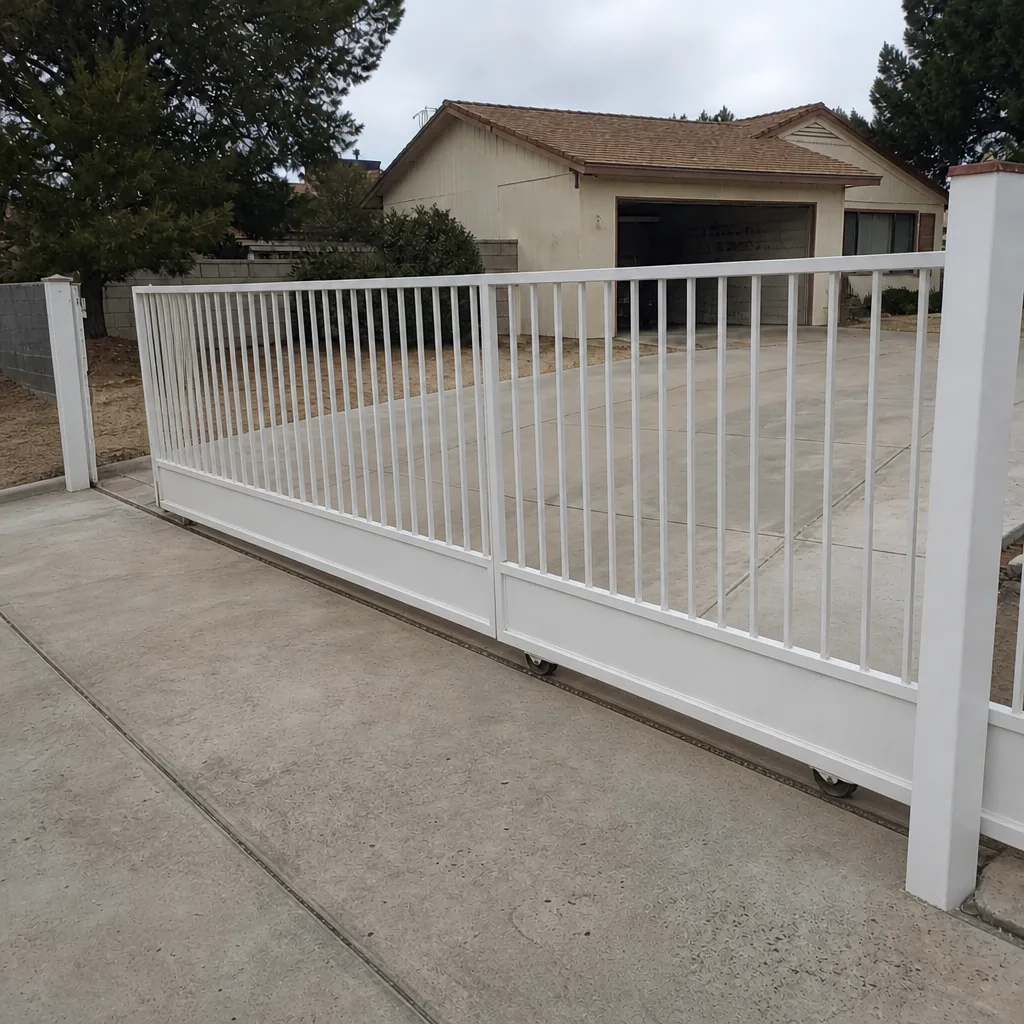
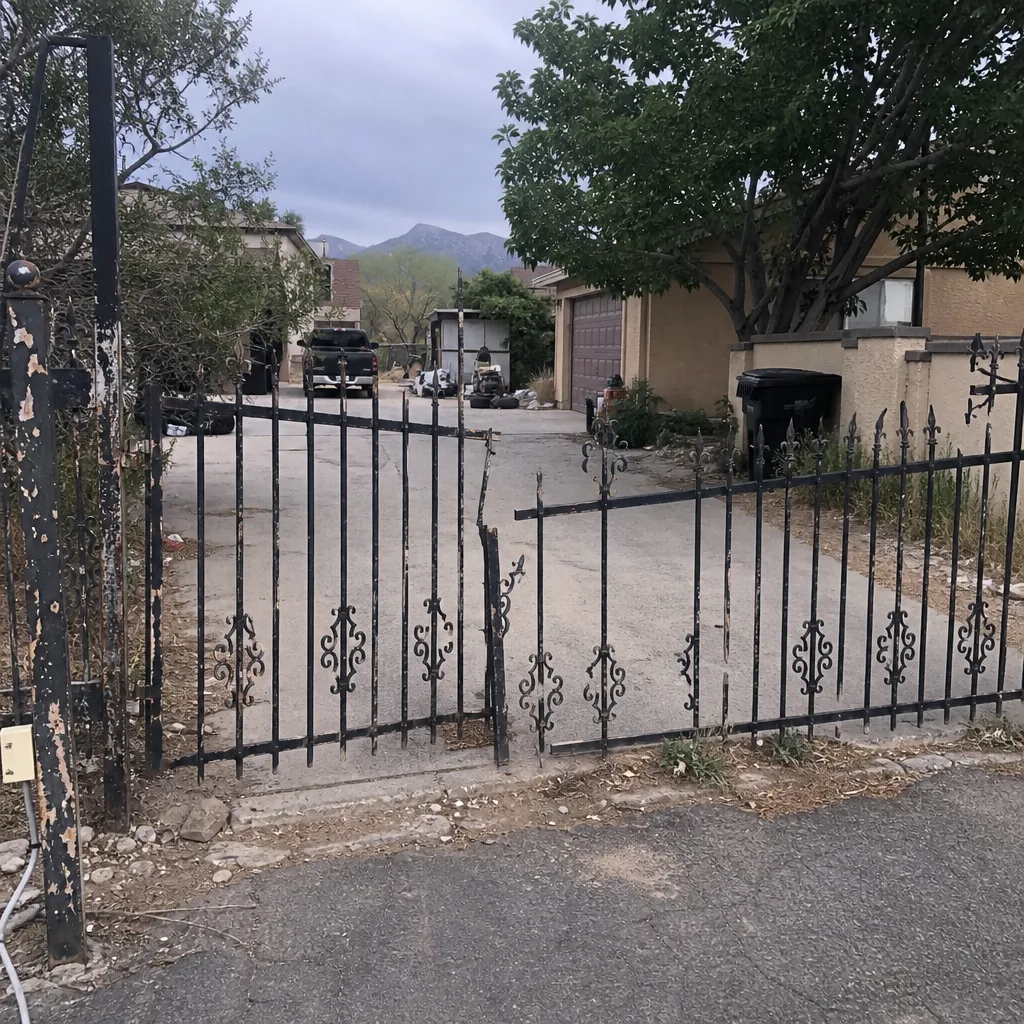
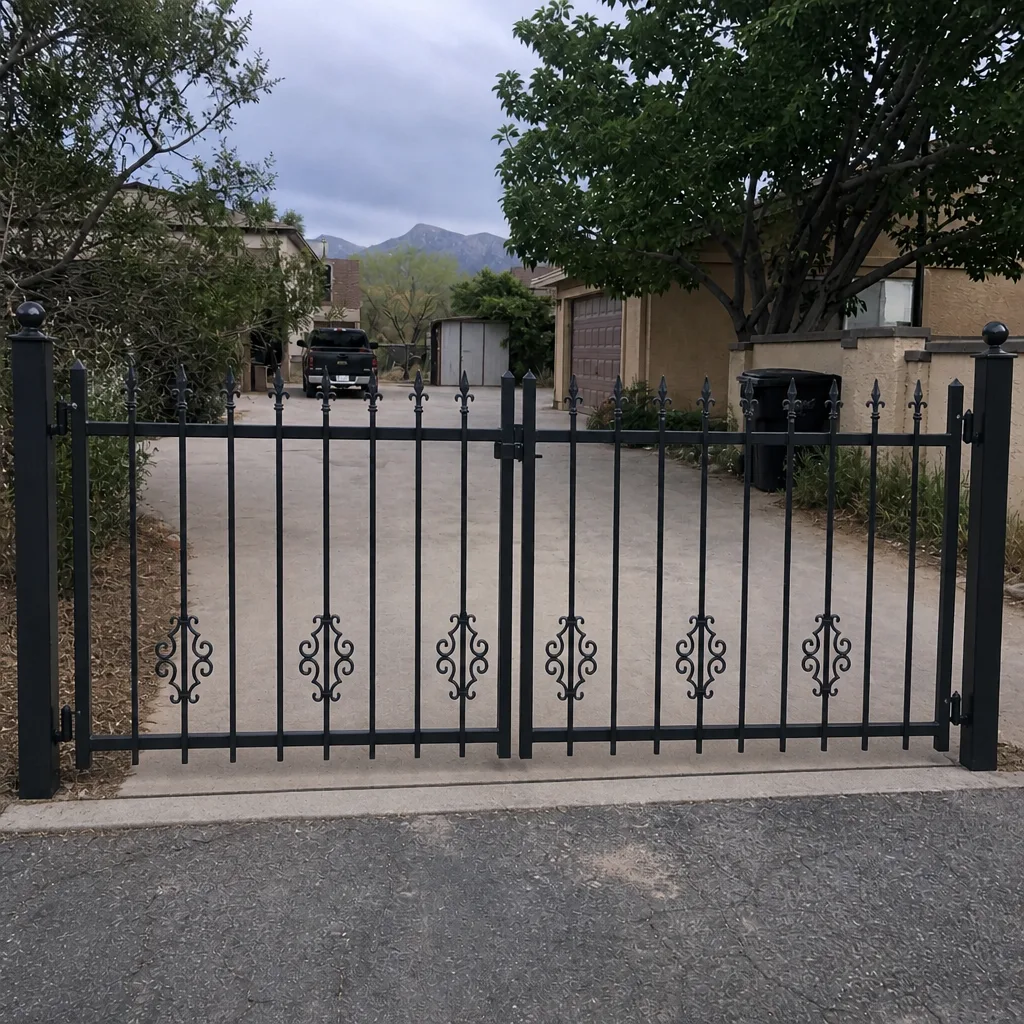
See the difference
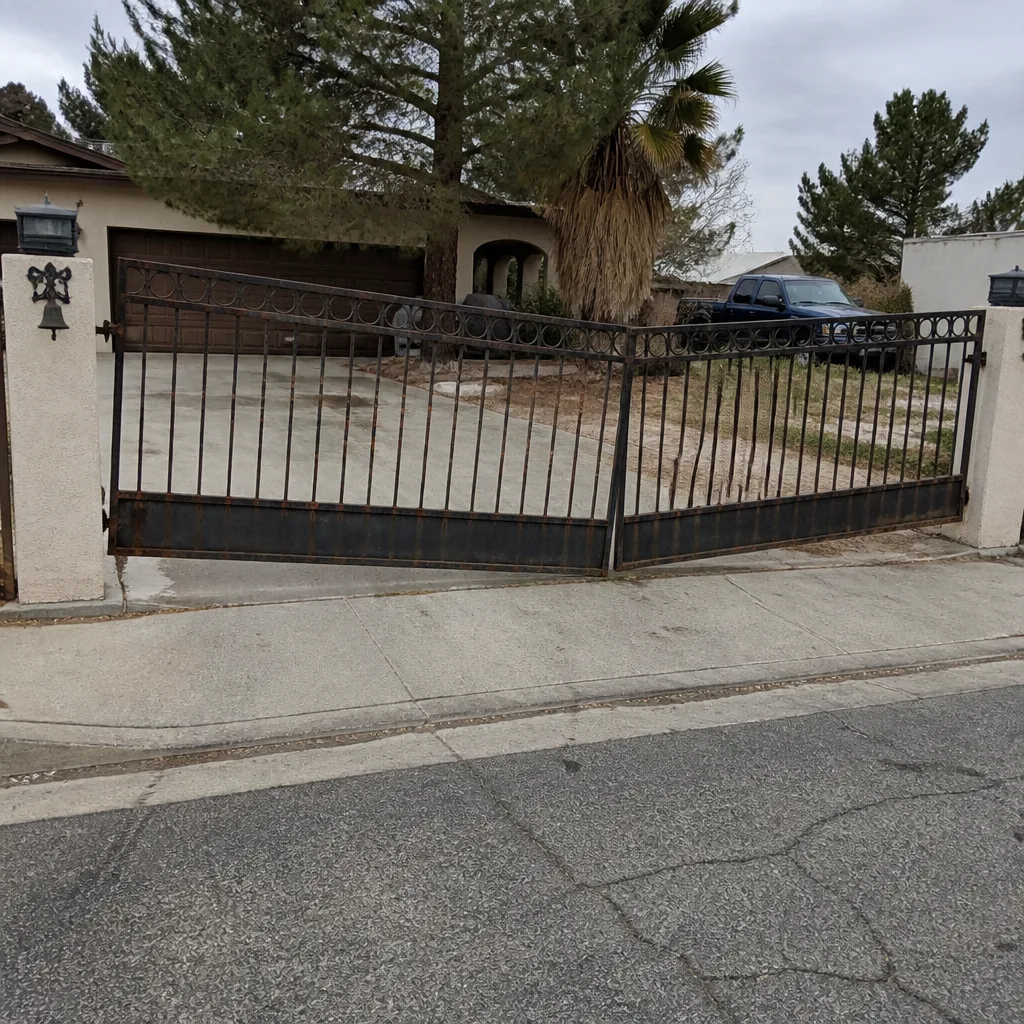 Before
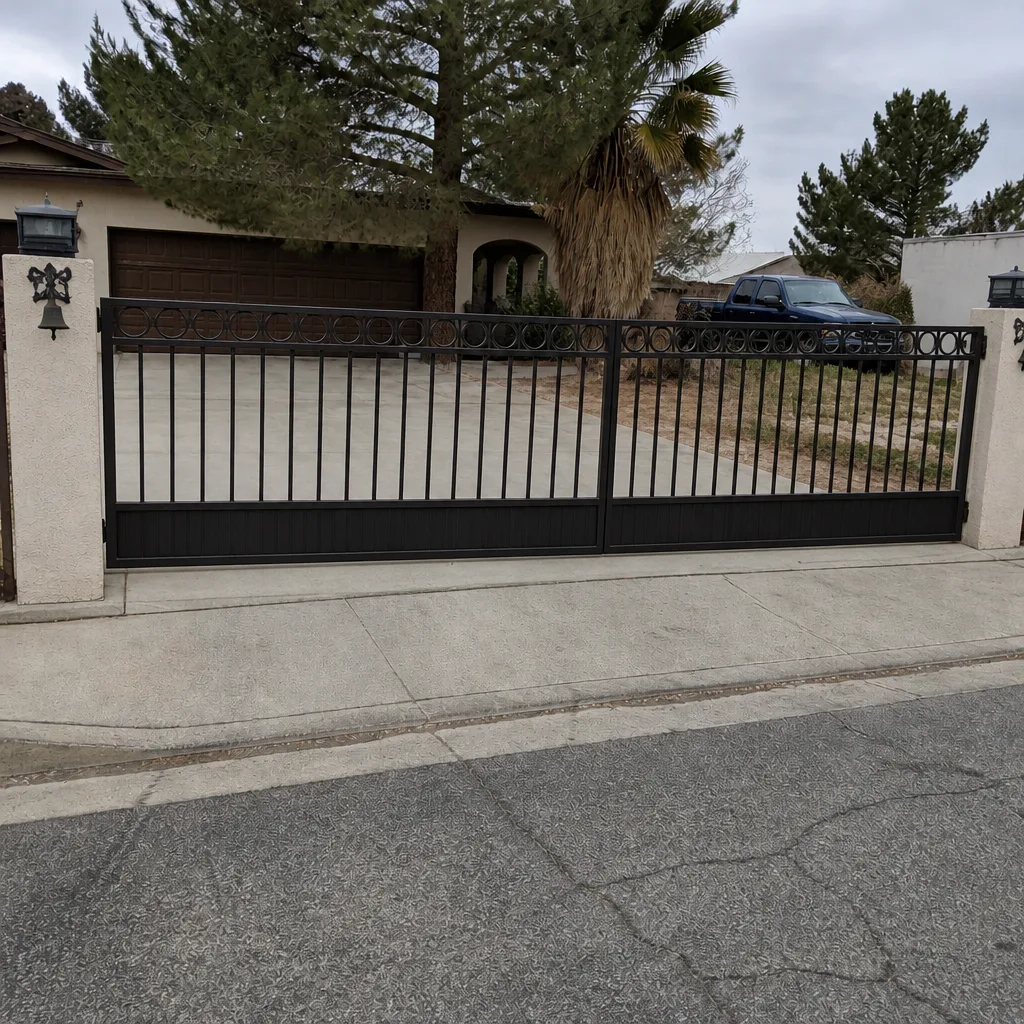 After
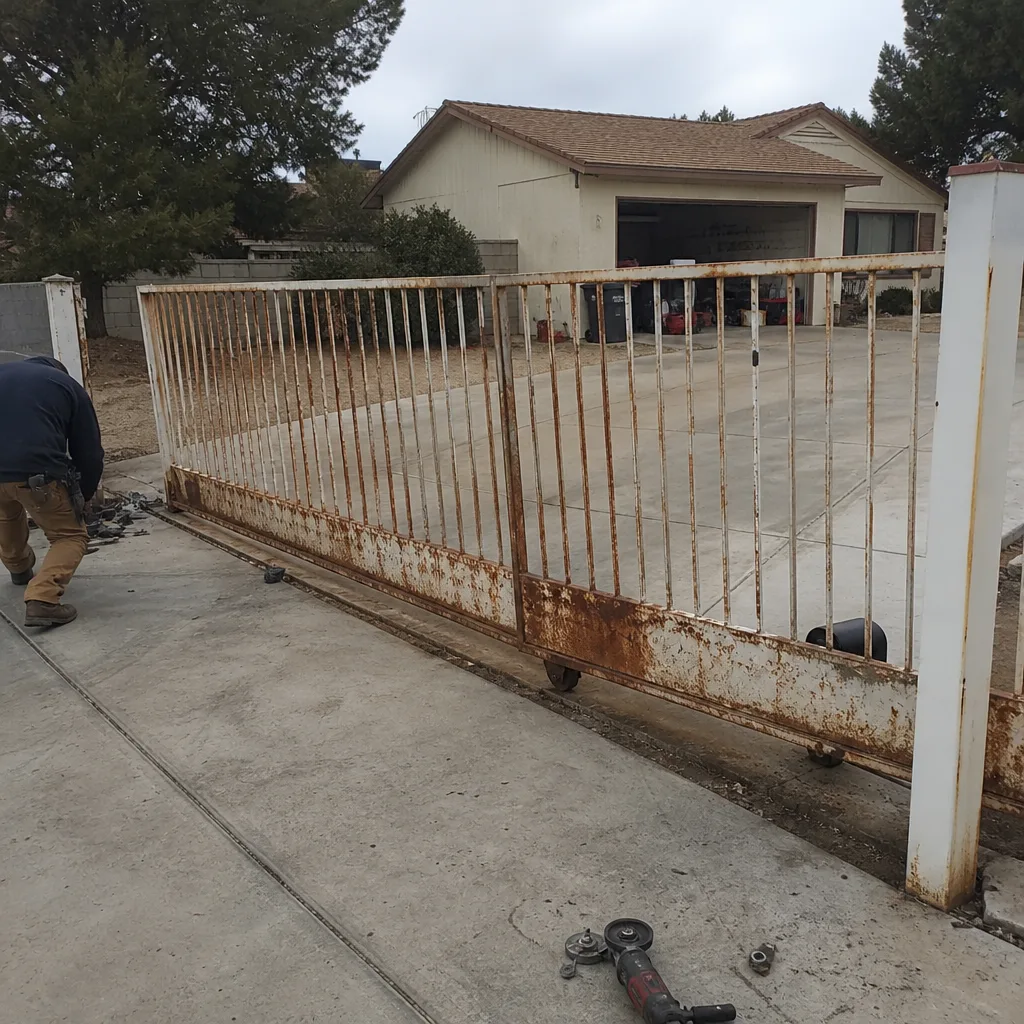 Before
 After
 Before
 After
When to Call a Professional
Some gate work is appropriately a homeowner project, and some isn’t. Call a professional when the work involves structural welding, footings in caliche-heavy ground, gate operators or access control, or any sign of a failing post at grade. Don’t attempt to weld a load-bearing gate frame or dig a structural footing through caliche on your own – the risk of a gate that fails under its own weight is real, and the thermal conditions here make the margin for error tighter than in most places. Also call us if the gate has begun to bind, sag, or drag; that’s usually a geometry problem that needs a spec-level fix, not a bigger motor. Ironworks Gate Co. Mesquite offers free estimates in Mesquite – call (844) 797-2573.
Frequently Asked Questions
Expect 5 to 10 years on quality hinges, less on cheap ones. Desert heat cooks the grease out and grit wears the hinge faster than in cooler climates. Annual inspection and re-greasing extends the life, and catching wear early is why an $89 tune-up costs far less than a hinge-set replacement.
Most welds can be made in place. Frame cracks, hinge reinforcement, and post repairs are routinely welded on-site. Large frame rebuilds or full fabrication are usually done in a shop for accuracy. Either way, the process and post-weld treatment should be in the quote.
Thermal expansion. Steel grows in the heat, and a gate with tight clearances will close up during the day. The fix is hinge and geometry adjustment, not forcing it. A binding gate loads your operator and hinges, so address it before it causes a bigger repair.
Structural tube steel with a proper coating is the better choice for a large driveway gate, especially one that gets operated. Aluminum is a good choice for lighter decorative panels and walkway gates. The right answer depends on the weight and duty of the gate, not on which metal sounds more premium.
Hot-dip galvanizing coats steel in zinc that corrodes sacrificially, so the metal underneath stays protected even where the coating is nicked. In Mesquite’s alkaline soil and UV, it’s the best protection you can buy for the steel itself, and it’s worth the extra cost. We recommend it for posts and frames that will be in the ground or exposed to the sun.
We service the major operator brands, including FAAC, BFT, Linear, and Viking. A generalist without brand-specific parts often substitutes the wrong control board or receiver. That’s one reason a same-visit fix works better with a specialist who has the right parts identified.
The Bottom Line
The right parts and the right welding for a Mesquite gate are not the same parts and welds that work in other climates. Alkaline soil and caliche attack posts below grade, UV and heat attack coating and hardware above grade, and daily thermal cycles stress geometry and welds year-round. Spec structural tube steel with hot-dip galvanizing, keep clearances generous at the hinge, choose quality hardware, and maintain the coating annually. Compare bids on process, metal spec, and post-weld treatment, not just price. Get those things right and a Mesquite gate will last decades instead of a few summers.
If you’re not sure what stage your gate is at, or you want a written estimate compared against another quote, Ironworks Gate Co. Mesquite is here. Call (844) 797-2573 for a free estimate. A live person answers the phone, background-checked technicians handle the work, and every job is covered by the written 90-Day Done Right Promise. These are the parts and welding standards we hold for a gate in this town, and getting the job done right the first time is the whole point.
Written by the team at Ironworks Gate Co. Mesquite.