
Last updated November 17, 2026
 Wrought iron
 Wood & steel frame
 Farm & ranch
 Sliding driveway gates
 LiftMaster operators
Free on-site gate assessment - hinges, posts, and your LiftMaster or Nice gate operator checked before anything is quoted
The assessment is free and the quote is the invoice.
Get your free estimateGate Repair Maintenance Schedule: What to Do and When
If you’re lubricating your gate on a January-April-July-October schedule, you’re doing it at the wrong times. The two most damaging periods for a Mesquite gate are May, when the pre-summer heat bakes out every old lubricant on the hinges, and September, when monsoon dust and grit have worked their way into every moving part. No standard maintenance calendar accounts for that. A gate maintenance schedule should follow the stresses the gate actually faces, not the tidy quarters on a wall planner. In this guide we’ll walk through the schedule that fits a desert climate, the tasks that genuinely prevent failure, the ones that only look good, and the single structural check almost no homeowner performs that predicts most gate failures before they happen.
Quick Answer
For a Mesquite gate, the maintenance calendar should be front-loaded around summer heat and monsoon season: a deep service in late April or early May before the worst heat, a second full check in September after monsoon dust settles, and lighter battery and hardware checks in between. The tasks that matter most are hinge pin inspection, lubricant that survives above 110°F, and battery backup testing every few months rather than once a year.
Styles & brands we work with
- Wrought iron
- Wood & steel frame
- Farm & ranch
- Sliding driveway gates
- LiftMaster operators
Table of Contents
- Why a Desert Gate Needs Its Own Calendar
- The Mesquite Seasonal Maintenance Calendar
- Preventive Tasks vs. Cosmetic Tasks: What’s Actually Worth Doing
- Lubricants That Hold Up Above 110°F
- Battery Backup Testing: Why Once a Year Isn’t Enough
- The Hinge Pin Check That Predicts Most Failures
- A Step-by-Step Maintenance Walkthrough
- When to Call a Professional
Why a Desert Gate Needs Its Own Calendar
A gate in Mesquite lives a different life than a gate in a coastal town. The metal swings through temperature swings of forty degrees or more in a single day, the summer sun heats a steel frame until it’s too hot to touch, and the monsoon season drives fine sand into every hinge, roller, and track. Those are the stresses that break gates, and they cluster at specific times of year. A January gate is a different animal from a September gate.
The standard quarterly calendar was written for a mild climate where the main enemy is rain. That’s not the problem here. In Mesquite, the problem is heat and dust. Heat drives lubricants out of bearings and makes metal expand enough to throw a latch out of alignment. Dust works into those same bearings and grinds them down from the inside. A gate that’s lubed in January and left alone until spring is running dry by April, just as the heat arrives.
We’ve seen the pattern repeat across Mesquite neighborhoods: a gate that gets serviced in spring and fall lasts years longer than one serviced on a strict quarterly schedule that ignores the seasons. The gate tells you what it needs if you know when to look.
The Mesquite Seasonal Maintenance Calendar
Here’s the calendar we recommend for Mesquite-area gates. It’s built around the two stress points that matter most, not evenly spaced intervals.
- Late April to early May (pre-heat deep service): This is the most important service of the year. Clean and re-lubricate every hinge, roller, and track with a high-temperature lubricant before the first stretch of triple-digit days. Inspect hinge pins for wear (more on this below). Test the motor’s manual release. Check the battery backup under load. Tighten all fasteners, which have a habit of loosening as metal expands in early heat.
- June through August (light checks): Mid-summer is too hot for heavy work. Every few weeks, walk the gate and listen. Look for binding, sagging, or a motor running louder than usual. Wipe dust off photo-eye lenses. Re-test the battery backup once mid-summer, because power fluctuations peak alongside air-conditioner demand.
- September (post-monsoon recovery): The second big service. Monsoon grit will have worked into every moving part. Clean it out, check for sand-packed tracks, inspect the welds at the hinge mounts for cracking, and re-lubricate. This is the service that catches the problems the summer created.
- November through March (light maintenance): Winter is the easy stretch in Mesquite. Clean and lubricate on a normal schedule, test the safety system monthly, and look for anything the summer exposed. Belts and chains inspected now get replaced before spring stress arrives.
That’s four window-focused service points, but only two of them are deep services. The May and September appointments do the heavy work; the summer and winter checks are short and light. That’s the shape a real desert gate calendar takes.
Preventive Tasks vs. Cosmetic Tasks: What’s Actually Worth Doing
Not every maintenance task is created equal. Some keep the gate from failing. Others just keep it looking clean. Knowing the difference helps you spend your time and your service dollars on the things that matter.
Tasks that prevent failure:
- Hinge pin measurement and greasing (this predicts wear before it becomes failure)
- High-temperature lubricant application at the right time of year
- Battery backup load testing every few months
- Photo-eye and safety-edge testing (a safety system that fails stops the gate entirely)
- Weld inspection at hinge mounts and stress points
- Fastener torque checks (loose bolts lead to misalignment and motor strain)
Tasks that mostly extend cosmetic life:
- Repainting or touching up finish (worth doing, but it won’t stop the gate from failing)
- Cosmetic cleaning of decorative panels and scrollwork
- Polishing accessible chrome or hardware
- Removing light surface dust from framing (deep cleaning of mechanisms is different)
Both lists matter, but if you can only do one on a given weekend, do the first. A repainted gate with a dry hinge pin still fails. A lubricated gate with a slightly faded finish opens every morning like it always has. Our Gate Repair in Mesquite service is built around the first list, which is where failures actually live.
Lubricants That Hold Up Above 110°F
This is where most Mesquite homeowners go wrong. The lubricant that works in a milder climate breaks down in the summer heat. A thin oil sprays on easily and feels like it’s doing its job – and then evaporates off a hot hinge by late June. A wax-based chain lube that works beautifully on a garage door may not survive a steel gate that’s near 150°F on the surface in July.
What holds up in Mesquite heat:
- Lithium complex grease: High-temperature lithium grease stays put on hinge pins and bearing surfaces where temperatures regularly exceed 110°F. It doesn’t run off and it holds up through summer.
- Silicone-based lubricants for rubber and plastic: Safe on weather seals and photo-eye hardware, and doesn’t break down the trim it touches.
- Dry-film PTFE lubricants for accessible tracks and rollers: These go on as a film and don’t attract dust like wet lubricants do. That’s the key advantage in a dusty climate.
What breaks down and causes problems:
- Light machine oils and spray-on oils: Run off or evaporate quickly in heat, leaving the surface dry within weeks.
- General-purpose household greases: Typically don’t have the heat tolerance for a hot gate, and can attract and hold dust when they soften.
- Thick wet lubricants on exterior tracks: Any wet lubricant that stays tacky will collect monsoon dust, and once it’s loaded with grit it grinds the track every time the gate moves.
The safe rule: on high-heat bearing surfaces, use a high-temperature grease. On tracks, rollers, and any exposed sliding surfaces that live in the dust, use a dry-film or silicone-based product. The dry film may look less “lubricated” than a shiny wet grease – but in Mesquite it lasts far longer and does less damage.
Battery Backup Testing: Why Once a Year Isn’t Enough
Battery backups on automatic gates are like smoke detectors: they work until they don’t, and you find out at the worst possible time. In areas with summer power fluctuations – and Mesquite sees plenty as air-conditioners run nonstop and the grid takes strain – a battery that failed in April burns out your gate’s motor in July.
A battery should be tested under load, not just for voltage. A voltmeter alone will read 13.5V on a battery that can’t actually push the gate open. The load test is the test that matters, and the practical schedule for Mesquite is every three months, at minimum. Most gate and opener manuals suggest yearly testing; in this climate that’s not enough.
How to test it (or how a technician tests it):
- Disconnect the gate’s main power source (or flip the breaker to the operator).
- Trigger the gate to open using the remote or keypad.
- Watch how the gate moves. It should open at close to normal speed and without strain.
- Let it finish the cycle, then close it. Listen for a slow motor, stuttering, or a stall.
- If anything hesitates, plan on a battery replacement.
- Reconnect main power and confirm the system is charging the battery.
If a gate carries a Gate Motor & Opener in Mesquite system from a brand like FAAC or Viking, the operator’s manual will have model-specific battery information. Refer to it, and if you’re not sure whether a battery is at end of life, ask a technician. The cost of a battery is trivial next to the cost of an opener that burns out after a power outage.
See the difference
 Before
 After
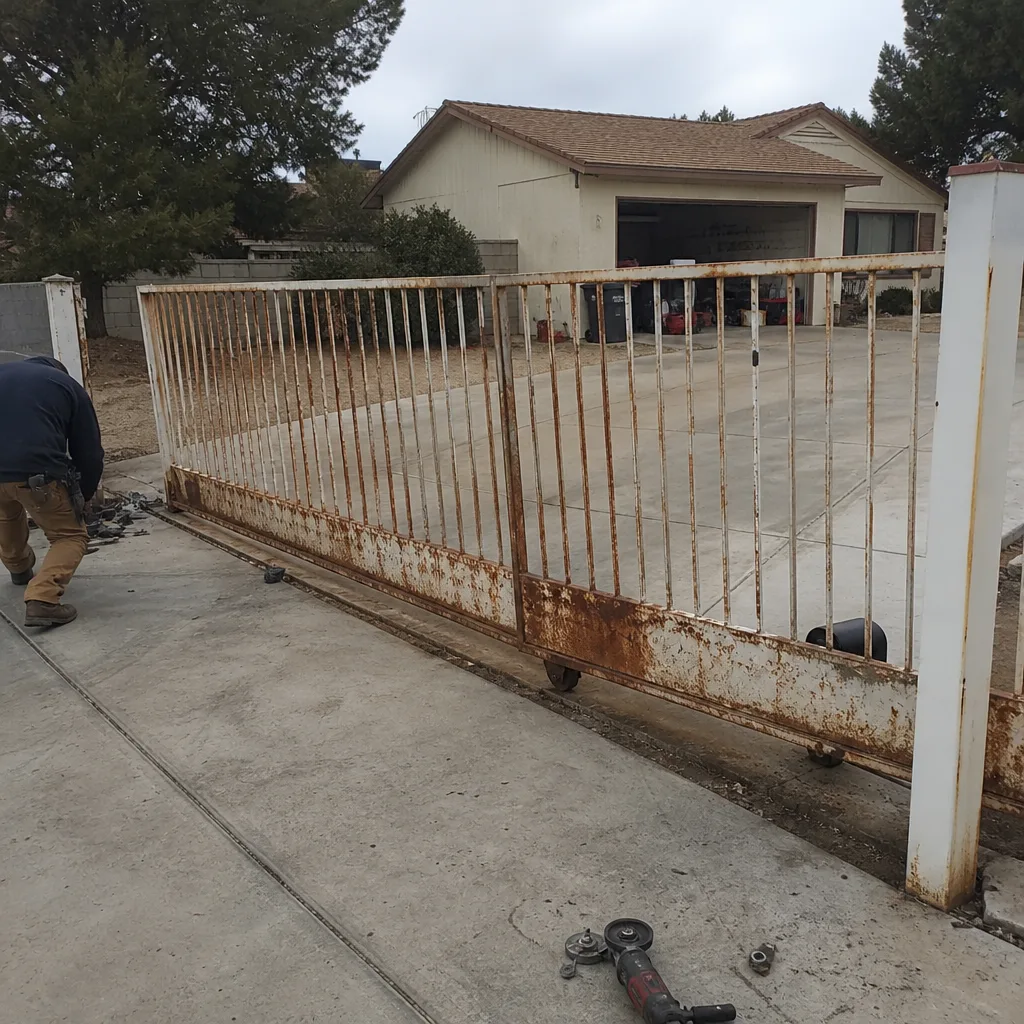 Before
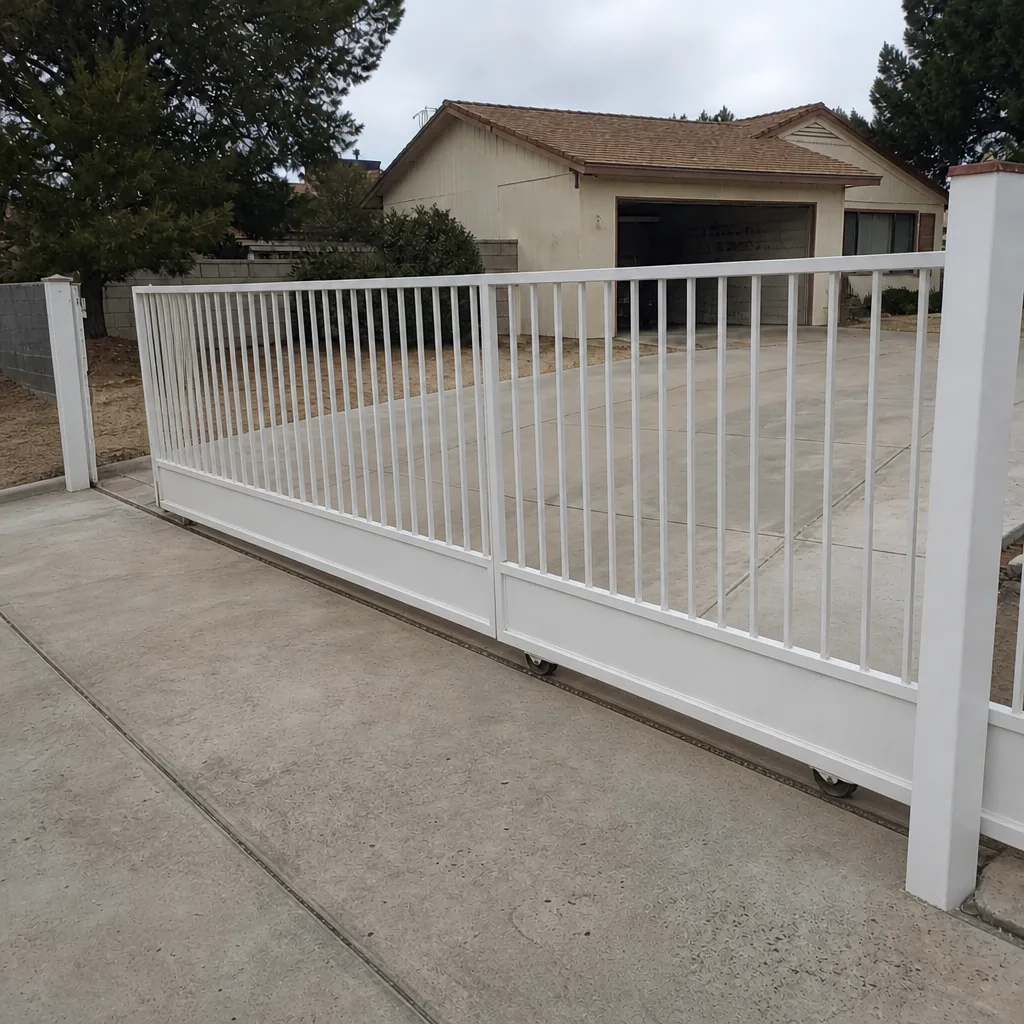 After
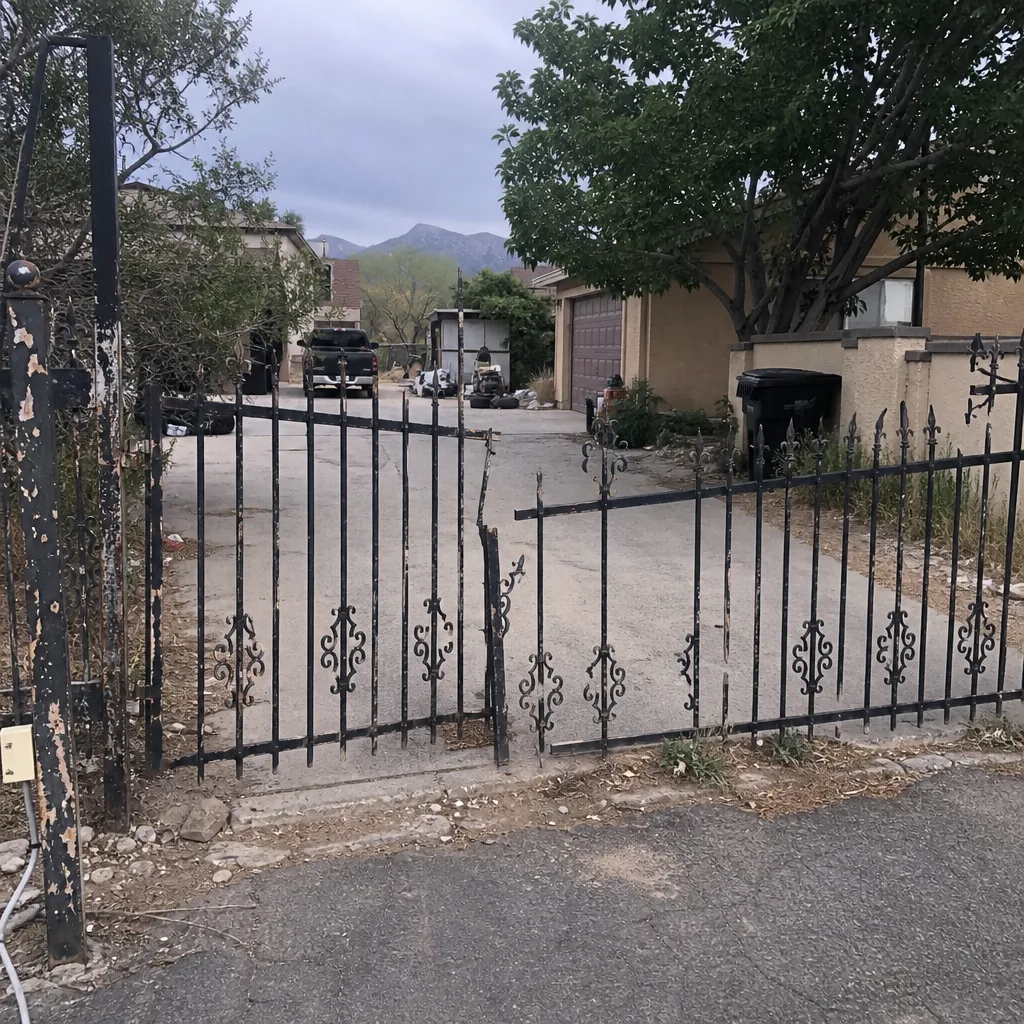 Before
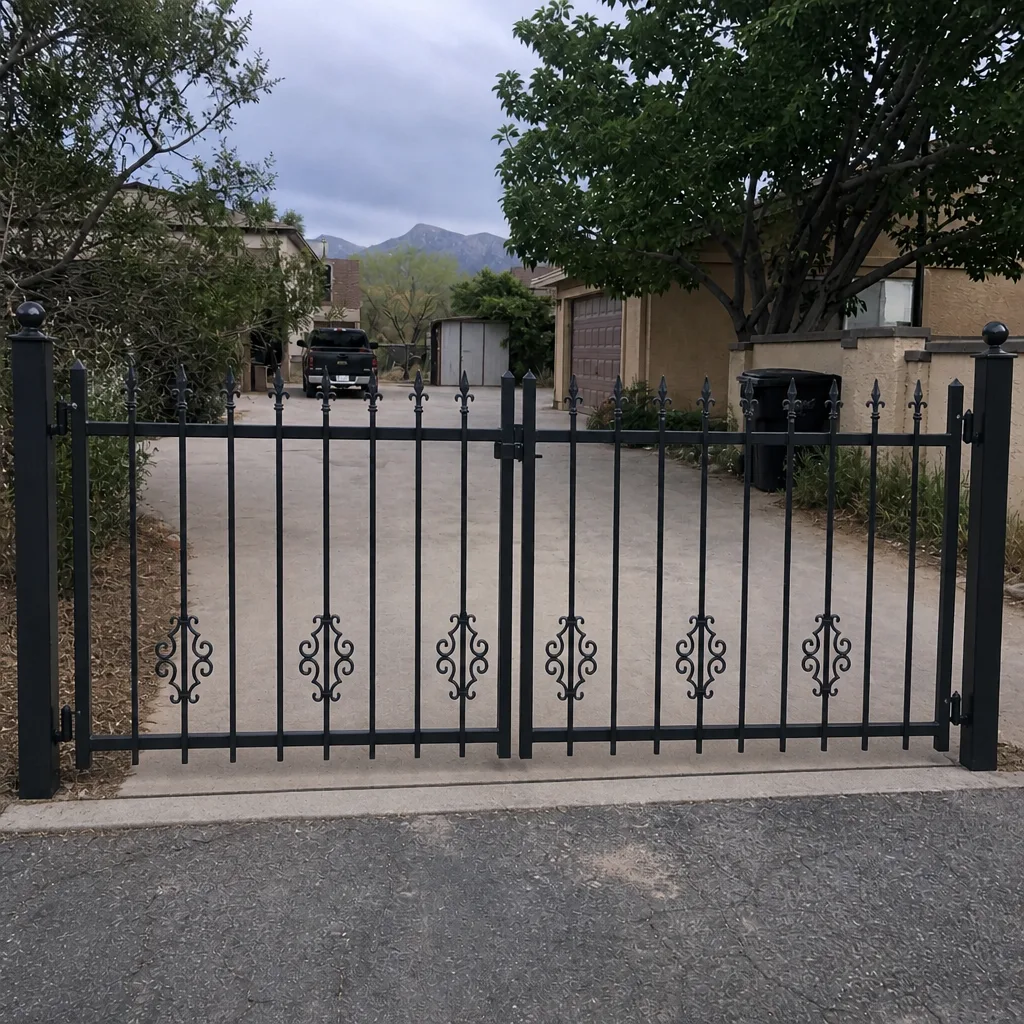 After
The Hinge Pin Check That Predicts Most Failures
This is the one that catches almost everyone. Most homeowners do a visual inspection of their gate and see it swinging. It looks fine. What they don’t do is measure the hinge pin wear, and that’s the check that predicts roughly 60% of gate failures well before they happen.
Here’s why it matters: hinge pins are the pivot points the entire gate turns on. When a hinge pin wears, the gate sags – slightly at first, then more over time. A sagging gate strains the operator’s motor, wears out the latch alignment, and eventually grinds metal-on-metal. What looks like “the motor is failing” is often just a worn hinge pin causing the motor to work harder than it should.
How to check for hinge pin wear:
- Open the gate to the halfway position. This puts weight on the hinge pins without fully extending them.
- Grasp the free edge of the gate and try to lift it vertically. A healthy pin allows less than a millimeter of play.
- Look at the gap between the gate frame and the hinges. Even gaps across all hinges are good; uneven gaps signal wear on one.
- Swing the gate slowly and listen for a low grind or crunch. That’s metal contacting metal where the joint should be gliding on grease.
- Measure the hinge pin diameter with calipers if you have them, or compare to a new pin if you can. If the pin has visible flat spots or is noticeably thinner than its siblings, replace it.
This check takes five minutes and predates almost every gate failure we’ve seen on a Mesquite gate. It’s also the check most homeowners never perform because visually the gate still works. The gate looks fine right up until it doesn’t.
A Step-by-Step Maintenance Walkthrough
Here’s the sequence for a proper maintenance session. The tools are simple: a grease gun, a rag, calipers, a flashlight, and a bit of patience. This walkthrough is for the maintenance tasks a homeowner can safely handle – anything involving springs, high-tension cables, or motor internals belongs with a trained technician.
- 1
Walk the gate. Before you do anything, open it fully and close it slowly. Listen. Look. Feel. Note any binding, squeaking, sagging, or listening for the motor straining.
- 2
Test the safety system. Wave a hand across the photo eyes mid-swing and confirm the gate reverses or stops. Press the safety edge (if the gate has one) and confirm the same.
- 3
Clean the mechanism. Wipe dust and grit off every hinge, roller, and track with a dry rag. If tracks are packed with grit, use a soft brush before lubricating. Never lubricate over grit.
- 4
Grease the hinge pins. Use a high-temperature lithium grease on every hinge pin. Grease each pin fully, and wipe away the excess. If a hinge pin has visible wear, replace it now rather than later.
- 5
Lubricate tracks and rollers with a dry-film product. A PTFE dry film is the workhorse here in a dusty climate.
- 6
Test the battery backup. Run through the load test above.
- 7
Inspect the welds. Use a flashlight to look at the welds where the hinges meet the gate frame. Any crack, rust line, or separation is worth a call. Welding a failing hinge mount is a job for a professional.
- 8
Tighten all fasteners. Every bolt, every bracket, every mounting plate. Metal expands in Mesquite heat and loosens slightly; a torque check now saves a motor later.
That’s the whole cycle, and the two sessions that matter most are the pre-heat one in late April or early May and the post-monsoon one in September. Everything else is lighter. If the gate is showing signs of wear that go beyond maintenance, or you want to know whether it’s due for replacement, our Gate Installation in Mesquite is a fair conversation to have early rather than late.
Common Mistakes to Avoid
- Following a generic quarterly calendar. Mesquite’s climate doesn’t match a coastal or Midwestern schedule. If your maintenance calendar has evenly spaced quarterly duties, you’re lubricating in January and missing the pre-heat service that actually prevents summer damage.
- Using the wrong lubricant. Light oils and household greases break down in heat, run off, or attract dust that turns into grinding paste. Use high-temperature grease on bearings and dry-film on tracks.
- Testing the battery with a voltmeter only. A battery can read full voltage and still be dead under load. Only a load test tells the truth.
- Assuming a sagging gate means a bad motor. Most of the time, it’s a worn hinge pin. Diagnose the pin first, before replacing an operator that was working fine.
- Lubricating without cleaning first. Grease over grit is worse than no grease at all. Always clean before you lubricate.
- Skipping the weld inspection. Cracks in hinge-mount welds start small and fail fast. A flashlight and a two-minute look saves a gate.
- Trying to service the spring or counterbalance yourself. Gate and door springs store enormous tension. Any adjustment belongs with a trained technician – this is genuinely a safety issue, not an upsell.
When to Call a Professional
Some tasks are comfortably in a homeowner’s wheelhouse: wiping down tracks, greasing hinge pins, and load testing a battery. Others are not. Call a technician when you see a crack in a weld at any hinge mount, when a gate has begun to sag noticeably, when the motor strains or reverses mid-travel, when a safety system won’t reset, or any time the gate or its operator contains a spring or cable under tension that needs adjusting. Those are the jobs where the wrong move is genuinely dangerous – springs and counterbalance mechanisms hold tremendous energy, and a slip can turn a repair into an injury. If you’re in Mesquite and want a professional read on your gate’s condition, Ironworks Gate Co. Mesquite offers free estimates in Mesquite – call (844) 797-2573. We’ll tell you honestly whether it’s a maintenance job, a repair, or a replacement.
Frequently Asked Questions
Twice a year for a deep service – once in late April or early May before the summer heat, and once in September after monsoon season – with light checks in between. That’s roughly double what a generic quarterly schedule would prescribe for the important tasks, and it’s built around the two stress points that matter most here. Call (844) 797-2573 for a scheduling consultation – estimates are free.
High-temperature lithium grease on hinge pins and bearings, and a dry-film PTFE lubricant on tracks and rollers. Light oils and household greases break down or turn tacky and attract dust, so they cost you more over a summer than they save. Call (844) 797-2573 to ask what’s right for your specific gate and operator.
Usually, a worn hinge pin. A pin that’s a millimeter out of spec can create enough drag to make the motor work much harder than it should, and the wear happens invisibly while the gate keeps opening. Diagnose the hinges before you replace the motor. Call (844) 797-2573 for a free estimate on a proper diagnosis.
Every three months, at minimum, and always under a load test rather than a voltage-only check. Mesquite’s summer power fluctuations make the battery the most overlooked point of failure on an automatic gate. Call (844) 797-2573 if you want a battery tested and confirmed.
Lubrication, cleaning, and battery testing are fine for a homeowner who’s careful. Anything involving springs, counterbalance mechanisms, high-tension cables, or motor internals is genuinely dangerous and belongs with a trained technician. When in doubt, call (844) 797-2573 – estimates are free.
If hinges have gone loose at the mount, if welds are cracking, or if the gate has fallen out of alignment after years of desert heat and dust, it may be time for a repair or a replacement conversation. Our Ironworks Gate Co. Mesquite home and repair teams are set up for both, and Mesquite homeowners get a clear written estimate before any work starts. Call (844) 797-2573 to talk through it.
The Bottom Line
The right maintenance schedule for a Mesquite gate isn’t evenly spaced quarters – it’s front-loaded into the two weeks before summer heat and the weeks after monsoon dust settles. Lubricate with high-temperature products on bearings, dry-film products on tracks, and clean before you grease. Test the battery under load every three months. Measure hinge pin wear before you blame the motor. Skip the tasks that only look good and spend your time on the ones that prevent failure. And on anything involving springs, tensioned cables, or welds that have begun to fail, call a technician. If you want an honest read on your gate’s condition, Ironworks Gate Co. is here for Mesquite homeowners – call (844) 797-2573 for a free estimate.
Written by the team at Ironworks Gate Co. Mesquite.