
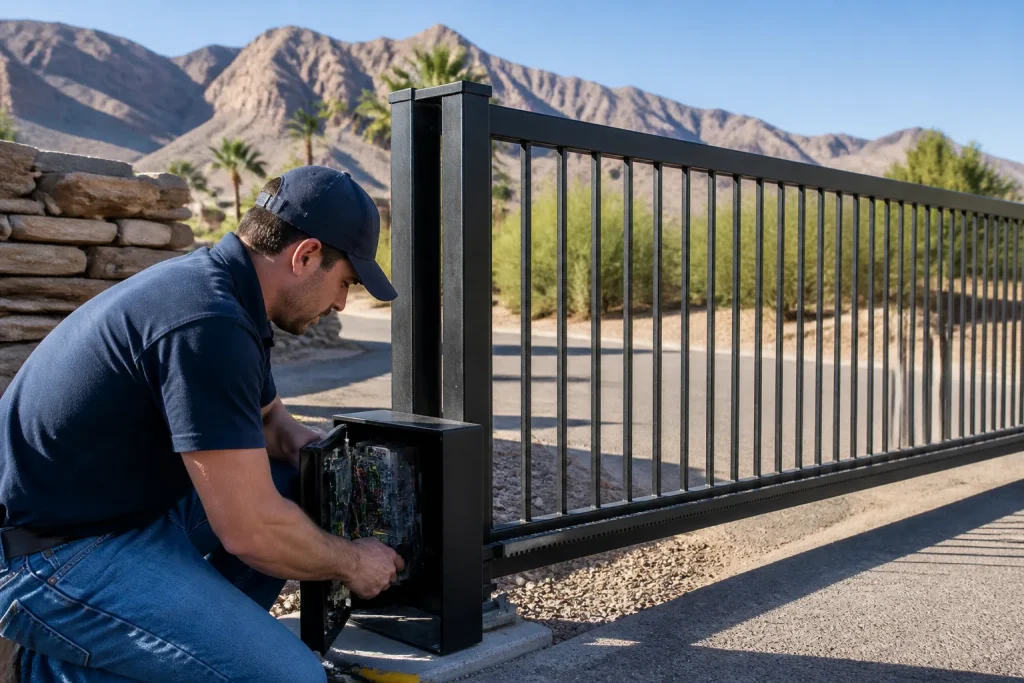
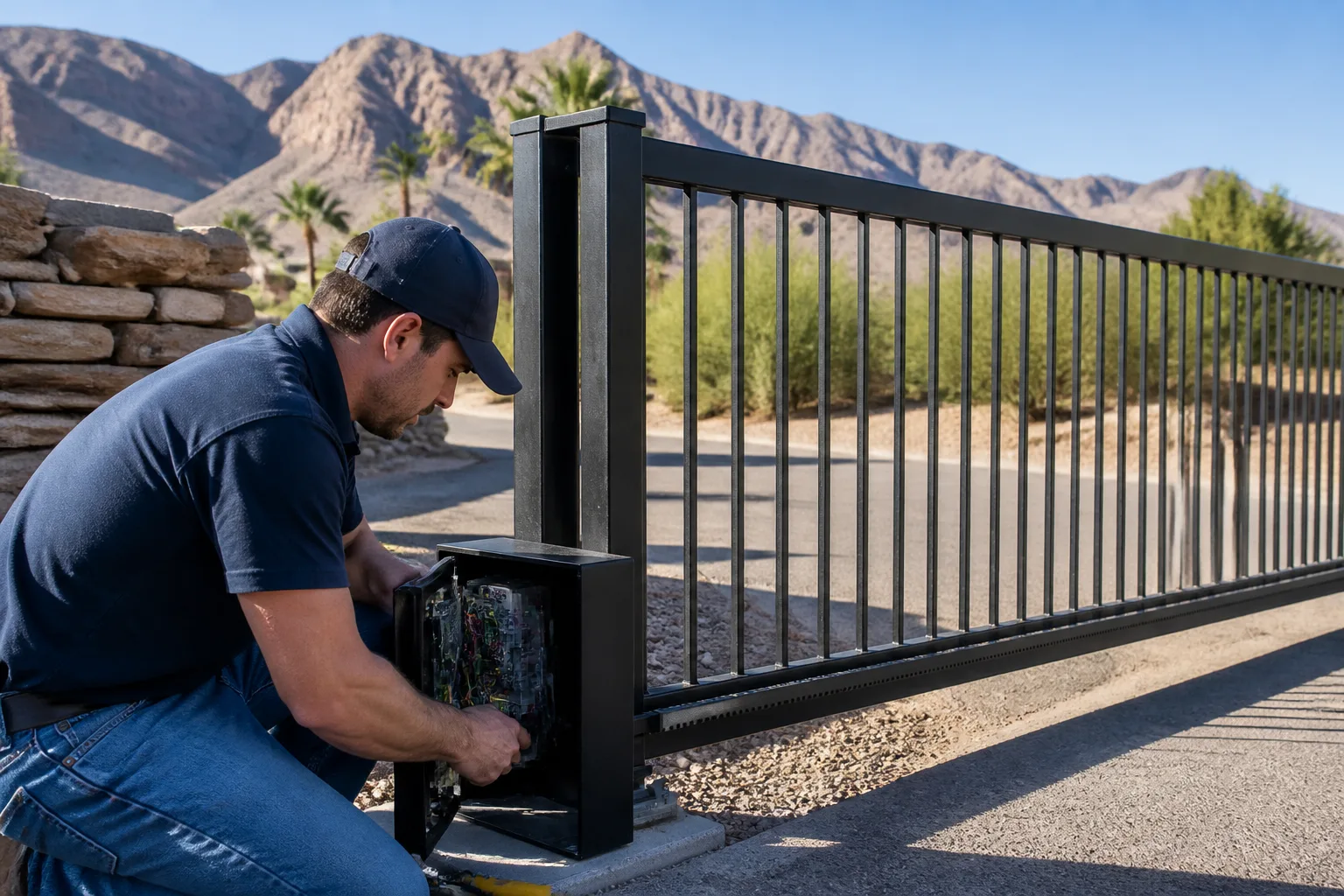
BFT Gate Repair in Mesquite: A Homeowner’s Guide
Your BFT operator has been trying to tell you what’s wrong since the moment it stopped. Every BFT control board runs a self-diagnostic routine and reports failures through a blinking LED on the board itself. Most technicians never look at it. They arrive, hear “the gate won’t open,” and start guessing. On a BFT unit, guessing is expensive, because the most common wrong guess is a new logic board when the real problem is a five-dollar wire or a track that’s drifted a quarter inch out of line. This guide explains how BFT systems think, so you can describe the problem accurately before anyone touches your gate.
If you would rather skip the detective work and have someone who knows BFT read the code for you, call (844) 797-2573. Estimates are free, and the price is settled before any work begins.
What Do BFT Blink Codes Actually Mean?
BFT logic boards flash the diagnostic LED in repeating sequences, and each sequence points to a specific fault category. The pattern matters more than the count: a steady rhythm of short flashes is a different message than a long pause followed by a burst.
Three sequences cover most of what we see on Mesquite gates:
- Two quick flashes, pause, repeat. The board is reporting a safety-device fault. In plain language: a photocell, safety edge, or the wiring feeding them is telling the board something is in the way when nothing is. This is the single most misdiagnosed BFT fault we encounter.
- Three flashes, pause, repeat. The encoder or limit-setting circuit is unhappy. The board has lost track of where the gate actually is, so it stops and reverses. On desert gates this often traces back to a gate leaf that’s sagging on its hinges, not a failed encoder.
- Rapid continuous flashing. The board is in a fault lockout after too many failed cycles. Sometimes a parameter reset clears it. Sometimes it means a component has genuinely failed. You can’t tell which from the blink alone, and neither can a technician until they test the circuit.
Here’s the catch: BFT doesn’t publish a single universal code chart across every model. A Phobos and a Virgo can flash differently for related faults. That’s exactly why reading the code without the model-specific manual leads people astray. Write down the sequence, note your model number, and you’ve given a technician a real head start. In our experience, a homeowner who arrives with “three flashes, model Virgo” saves a diagnostic visit almost every time.
Why BFT Gates Are More Sensitive to Track Misalignment Than Other Brands
This is the part that surprises people, and it’s worth understanding before you spend money on electronics.
BFT operators rely on encoder feedback: the motor continuously reports its position back to the logic board, and the board compares that report against the expected travel distance. If the gate meets unexpected resistance, the encoder reads a mismatch and the board stops and reverses the gate. That’s a safety feature, and it works well.
But it also means a BFT gate is far less forgiving of mechanical drift than a Linear or Viking unit with simpler limit-switch logic. When the track shifts, when a hinge wears, when a wheel flattens, the gate drags slightly. The encoder feels that drag and reports a fault. The board blinks a code. The homeowner assumes the board is dying.
It usually isn’t. In Mesquite’s heat, metal expands through the afternoon and contracts overnight, and a track that was true in March can be a quarter inch off by August. We’ve seen gates flagged as “board failure” that needed nothing more than a track realignment and two hinge bolts. Before anyone quotes you a control board, ask whether the gate has been tested for mechanical drag with the operator disengaged. That one question filters out a lot of unnecessary work.
The BFT Models Most Common in Mesquite – and Their Desert Wear Points
Most residential BFT installs in Mesquite run on two models: the Phobos, a compact unit common on single-leaf driveway gates, and the Virgo, which handles heavier leaves and shows up on wider entrances. Both are solid operators. Both have known wear points once they’ve spent five summers in desert heat.
What we look at first on a five-year-old BFT in Mesquite:
- The encoder wire and its connector. Heat cycling hardens the insulation and loosens the plug at the board. A loose encoder connector produces exactly the same symptoms as a failed board: erratic travel, random reversals, a three-flash code. It’s the cheapest thing to check and the most commonly missed.
- The limit cams and their set screws. Vibration walks them out of position over time. Once they drift, the gate over-travels, hits its physical stop, and the board faults out.
- Photocell lenses. Dust and fine sand pit the plastic and scatter the beam. The gate opens, then refuses to close because the safety circuit reads an obstruction that isn’t there.
- Motor brushes on the older Phobos units. After enough cycles, worn brushes cause intermittent starts. Homeowners describe it as “the gate thinks about it before it moves.”
None of these are exotic failures. They’re predictable, and a technician who works on BFT regularly knows the order to check them in. That’s why we’re trained and equipped across BFT alongside LiftMaster, FAAC, Linear, Viking, Ghost Controls, DoorKing, Elite, and Mighty Mule – the right diagnosis on the first visit beats a return trip every time.
Why a Faulty Photocell or Keypad Wire Looks Like a Dead Control Board
BFT designs its accessories to plug into the board rather than wire into it terminal by terminal. A photocell pair, a keypad receiver, a safety edge – each connects through its own plug. That architecture is genuinely convenient, and it’s also the source of the most expensive misdiagnosis in gate repair.
Here’s the mechanism. When an accessory fails or its loop wire gets damaged, the board doesn’t announce “photocell fault.” It simply stops completing cycles, and the diagnostic LED reports a safety-circuit problem. A technician without BFT experience reads that as “board is bad” and quotes a replacement. The real fault might be a keypad wire that a string trimmer nicked, or a photocell that took on water.
A few things worth knowing:
- Unplugging accessories one at a time is the standard test. Pull the photocell plug and the fault clears? The board is fine.
- Buried loop wire fails at the splice points first, not in the middle of the run. Check the splices before you dig.
- A keypad that works intermittently is often a battery or a wet receiver, not a board problem.
The practical takeaway for a Mesquite homeowner: if someone tells you the BFT board is dead, ask what happened when the accessories were unplugged. If there’s no answer, get a second opinion. We offer a free second opinion on any written estimate, and it’s a service people use more often than you’d expect.
What to Ask Before Anyone Quotes a BFT Board Replacement
A logic board for a BFT operator is a real expense. Before you approve one, these questions are fair to ask, and a technician who knows the brand will answer them without hesitation.
- “Did you read the blink code, and what was the sequence?” If they can’t tell you, they didn’t diagnose anything.
- “Did you test the encoder wire and connector?” This is the first thing to rule out on any erratic-travel BFT.
- “Did you unplug the accessories one at a time?” A photocell or keypad fault mimics a board failure.
- “Did you check the track and hinges with the operator disengaged?” Mechanical drag triggers encoder faults that look electrical.
- “Could a parameter reset or limit reconfiguration fix this instead?” Sometimes the board is healthy and just needs its travel limits relearned.
- “Is the price for the board, the labor, and the reprogramming settled in writing before you start?” Ours always is.
If the answers are solid, you’re in good hands. If they’re vague, you’ve just saved yourself the cost of a board your gate may not need. For an honest in-person read on the gate itself, our gate repair in Mesquite page covers what we check on every service call.
When to Call a Pro
Some things you can safely observe: note the blink sequence, watch whether the gate drags or binds by hand when the operator is off, and check that the photocell lenses are clean. Past that, a BFT operator holds stored energy and its board sits behind line voltage, and a gate leaf that’s come off its track or lost a hinge can swing unpredictably under its own weight. Testing circuits inside the control enclosure, adjusting limit cams under power, and working around a moving gate leaf are jobs for a trained technician. The 10 minutes you’d spend poking at a live board aren’t worth the risk.
If you’ve read the code and you want it handled correctly the first time, we’re set up for it. Our gate motor and opener service in Mesquite covers BFT and the other eight brands we’re certified on, and most repairs are completed in a single visit. New gate installations and replacements are measured and scheduled rather than rushed, and we walk the property and put the price in writing before anything is ordered. If you’re still deciding between repairing what you have and starting fresh, our gate installation in Mesquite page walks through what a full installation includes.
Related services in Mesquite: gate repair, gate motors and openers, gate installation, and access control and keypads.
The Bottom Line
BFT operators fail in patterns, and those patterns are readable. The blink code tells you the fault category. The encoder feedback loop explains why a misaligned track gets mistaken for a dead board. The plug-in accessory architecture explains why a wet photocell or a nicked keypad wire looks like a failed control board. Put those three facts together and you can walk into any repair conversation with the vocabulary to ask the right questions.
That’s most of what we want for Mesquite homeowners: not to repair the gate yourself, but to know when a quote makes sense and when it doesn’t. If you’re in Mesquite and need help with a BFT gate, Ironworks Gate Co. Mesquite offers free estimates – call (844) 797-2573. A live person answers, day or night. Every job is backed by our written 90-Day Done Right Promise.
Frequently Asked Questions
Most BFT repairs in Mesquite run somewhere in the range of a routine service call, while a logic board replacement costs substantially more in both parts and labor. The exact figure depends on your model and the fault. We quote and agree the price before any work starts, so the number you approve is the number on the bill. Call (844) 797-2573 for an exact quote – estimates are free.
No, and anyone who claims otherwise is guessing. The blink code narrows the fault to a category – safety device, encoder or limits, or a lockout – but confirming the actual failed component requires testing the encoder wire, unplugging accessories one at a time, and checking for mechanical drag. The code is a starting point, not a diagnosis. Call (844) 797-2573 and we’ll read it properly.
Usually not. Self-reversing is the encoder feedback system doing its job: it detected resistance or a position mismatch and backed the gate off for safety. The cause is more often a dragging track, a worn hinge, a loose encoder connector, or a photocell reading an obstruction. A board replacement is the last thing to try, not the first. Call (844) 797-2573 for a free second opinion on any written estimate.
For repairs, often yes – we aim to get to Mesquite repair calls quickly, and most repairs are finished in a single visit because our technicians are equipped for BFT, LiftMaster, FAAC, Linear, Viking, Ghost Controls, DoorKing, Elite, and Mighty Mule. New installations and full replacements are measured and scheduled, not same-day, since the work has to be ordered and planned. Call (844) 797-2573 and we’ll tell you honestly what your situation needs.
Written by the team at Ironworks Gate Co. Mesquite.
Need Gate Repair Help?
Call Ironworks Gate Co. Mesquite - licensed & insured, here with fast after-hours help in Mesquite.
(844) 797-2573